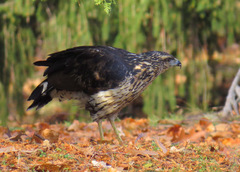
Great Black-Hawk

Great Black-Hawk

Buteogallus urubitinga

Silhouette: Sheatherius · PhyloPic

LCLeast ConcernNTVUENCR
Daily sighting probability ~70% · Very likely
at Parque Estadual Encontro das Águas

In 3 days >90%

1,648 Verified sightings at Parque Estadual Encontro das Águas From 2019 to 2026
5,182 In all 46 parks
July Best month
☀️ Diurnal When it's spotted

About the Great Black-Hawk

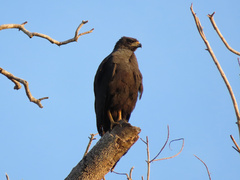
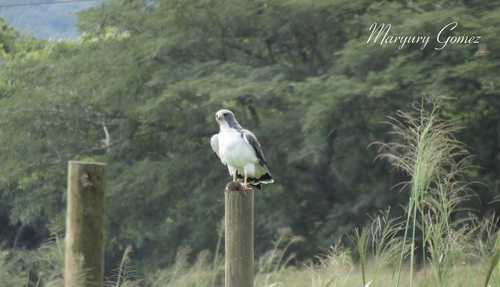
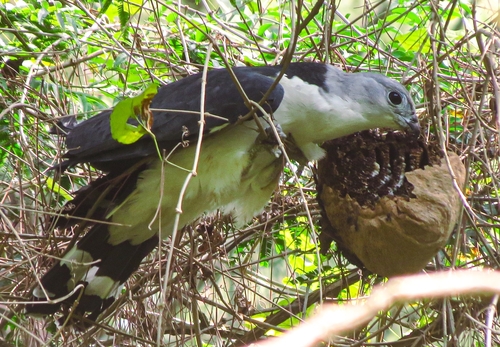
The great black hawk (Buteogallus urubitinga) is a bird of prey in the family Accipitridae, which also includes the eagles, hawks, and Old World vultures. The great black hawk was formally described in 1788 by the German naturalist Johann Friedrich Gmelin in his revised and expanded edition of Carl Linnaeus's Systema Naturae. He placed it with the eagles, hawks and relatives in the genus Falco and coined the binomial name Falco urubitinga. Gmelin's description was ultimately based on the "urubitinga" that had been described in 1648 by the German naturalist Georg Marcgrave in his Historia Naturalis Brasiliae. The great black hawk is now one of nine species placed in the genus Buteogallus was introduced in 1830 by the French naturalist René Lesson. The name genus is a portmanteau of Buteo, a genus introduced in 1779 by Bernard Germain de Lacépède for the buzzards and the genus Gallus introduced in 1760 by Mathurin Jacques Brisson for the junglefowl. The specific epithet urubitinga is from Tupi Urubú tinga meaning "big black bird" for such a raptor.

Two subspecies are recognised: Wikipedia →

Sounds

Song1:26

Paraguay · 2024

© Guillermo Menéndez (gmmv80) · XC958044 · CC BY-NC-SA 4.0

Call0:04

Brazil · 2024

© JAYRSON ARAUJO DE OLIVEIRA · XC884408 · CC BY-NC-SA 4.0

Canto0:41

Brazil · 2014

© Caio Brito · XC428132 · CC BY-NC-SA 4.0

Global Distribution

Parks Where Found

# Park Country Daily sighting probability
1 Parque Estadual Encontro das Águas 🇧🇷 Brazil
~70%
2 Main Ridge Forest Reserve 🇹🇹 Trinidad and Tobago
~40%
3 El Impenetrable National Park 🇦🇷 Argentina
~30%
4 Anavilhanas National Park 🇧🇷 Brazil
~20%
5 Iberá National Park 🇦🇷 Argentina
~10%
6 Amacayacu National Natural Park 🇨🇴 Colombia
~10%
7 Tambopata National Reserve 🇵🇪 Peru
~10%
8 Manu National Park 🇵🇪 Peru
~10%
9 Machalilla National Park 🇪🇨 Ecuador
~10%
10 Tayrona National Natural Park 🇨🇴 Colombia
<5%
11 El Palmar National Park 🇦🇷 Argentina
<5%
12 Henri Pittier National Park 🇻🇪 Venezuela
<5%
13 Calakmul Biosphere Reserve 🇲🇽 Mexico
<5%
14 Serra da Canastra National Park 🇧🇷 Brazil
<5%
15 Yasuní National Park 🇪🇨 Ecuador
<5%
16 Arenal Volcano National Park 🇨🇷 Costa Rica
<5%
17 Monteverde Cloud Forest Reserve 🇨🇷 Costa Rica
<5%
18 Soberanía National Park 🇵🇦 Panama
<5%
19 Cahuita National Park 🇨🇷 Costa Rica
<5%
20 Darién National Park 🇵🇦 Panama
<5%
21 Palo Verde National Park 🇨🇷 Costa Rica
<5%
22 Cockscomb Basin Wildlife Sanctuary 🇧🇿 Belize
<5%
23 Tenorio Volcano National Park 🇨🇷 Costa Rica
<5%
24 Santa Rosa National Park 🇨🇷 Costa Rica
<5%
25 Cuyabeno Wildlife Reserve 🇪🇨 Ecuador
<5%
26 Ostional Wildlife Refuge 🇨🇷 Costa Rica
<5%
27 Iguaçu National Park 🇧🇷 Brazil
<5%
28 Sian Ka'an Biosphere Reserve 🇲🇽 Mexico
<5%
29 Ría Lagartos Biosphere Reserve 🇲🇽 Mexico
<5%
30 La Amistad International Park (Panama) 🇵🇦 Panama
<5%
31 Braulio Carrillo National Park 🇨🇷 Costa Rica
<5%
32 Celestún Biosphere Reserve 🇲🇽 Mexico
<5%
33 Las Baulas Marine National Park 🇨🇷 Costa Rica
<5%
34 Iguazú National Park 🇦🇷 Argentina
<5%
35 Volcán Barú National Park 🇵🇦 Panama
<5%
36 Corcovado National Park 🇨🇷 Costa Rica
<5%
37 Gandoca-Manzanillo Wildlife Refuge 🇨🇷 Costa Rica
<5%
38 Manuel Antonio National Park 🇨🇷 Costa Rica
<5%
39 Chagres National Park 🇵🇦 Panama
<5%
40 Marino Ballena National Park 🇨🇷 Costa Rica
<5%
41 Carara National Park 🇨🇷 Costa Rica
<5%
42 Chirripó National Park 🇨🇷 Costa Rica
<5%
43 Parque Natural Metropolitano 🇵🇦 Panama
<5%
44 Bastimentos Island National Marine Park 🇵🇦 Panama
<5%
45 Tapantí-Macizo de la Muerte National Park 🇨🇷 Costa Rica
<5%
46 Poás Volcano National Park 🇨🇷 Costa Rica
<5%

Cities Where Found

# City Country Daily sighting probability
1 Goiânia 🇧🇷 Brazil
~10%
2 Asuncion 🇵🇾 Paraguay
~10%
3 João Pessoa 🇧🇷 Brazil
<5%
4 Campo Grande 🇧🇷 Brazil
<5%
5 Panama City 🇵🇦 Panama
<5%
6 Porto Alegre 🇧🇷 Brazil
<5%
7 Santos 🇧🇷 Brazil
<5%
8 Belo Horizonte 🇧🇷 Brazil
<5%
9 Caracas 🇻🇪 Venezuela
<5%

Zoos & Centres Where Found

# Zoo / Centre Country
1 São Paulo Zoo 🇧🇷 Brazil In captivity
2 Parque Municipal Summit 🇵🇦 Panama In captivity
3 Aviario Nacional de Colombia 🇨🇴 Colombia In captivity
4 Zoológico do CIGS 🇧🇷 Brazil In captivity
5 Refugio Silvestre Yanacocha 🇪🇨 Ecuador In captivity
6 Yanacocha Animal Rescue Centre 🇪🇨 Ecuador In captivity
7 El Nispero Zoo 🇵🇦 Panama In captivity
8 Parque dos Falcões 🇧🇷 Brazil In captivity
9 Zoológico de Canindé 🇧🇷 Brazil In captivity

Before you go

What are the chances of seeing a Great Black-Hawk in Parque Estadual Encontro das Águas?

Very likely

About 70% of wildlife watchers report a Great Black-Hawk sighting in Parque Estadual Encontro das Águas on a given day, based on 1,648 verified sightings from GBIF citizen-science data from 2019 to 2026. It is the 13th most-seen of the 308 birds we can rate there. Over three days the chance rises to over 90%, if each day is a fresh chance.

When is the best time to see a Great Black-Hawk in Parque Estadual Encontro das Águas?

July and August

In those months about 80% of wildlife watchers report a Great Black-Hawk in Parque Estadual Encontro das Águas on a given day, against about 60% in September–October and December, the lowest months. Those are among Parque Estadual Encontro das Águas's driest months, with about 10 mm of rain a month against 190 mm in January. January to April have too few records to rate.

What time of day is best to see a Great Black-Hawk?

Between 10 am and 1 pm

Across all the parks we cover, that three-hour window holds the most Great Black-Hawk sightings with a recorded time, and about 9 in 10 of them come between 6 am and 6 pm: it is a daytime animal.

Is Parque Estadual Encontro das Águas the best place to see a Great Black-Hawk?

Yes

Of the 46 parks where we can rate Great Black-Hawk sightings, Parque Estadual Encontro das Águas has the highest daily chance: about 70%. Next come Main Ridge Forest Reserve (Trinidad and Tobago, about 40%) and El Impenetrable National Park (Argentina, about 30%). All parks ranked.

Where does the Great Black-Hawk sighting chance come from?

GBIF citizen-science records

It is estimated from how often the Great Black-Hawk is recorded against all the birds logged in Parque Estadual Encontro das Águas (1,648 verified sightings from 2019 to 2026), calibrated against known sighting rates. Figures are rounded to the nearest 10% because citizen-science data supports honest approximations, not decimals, and months with records from fewer than five people show "—". How it works.

← Back to Parque Estadual Encontro das Águas