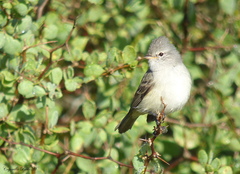
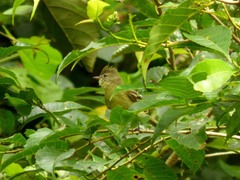

Southern Beardless-Tyrannulet

Southern Beardless-Tyrannulet

Camptostoma obsoletum

Silhouette: Emily Willoughby · PhyloPic

LCLeast ConcernNTVUENCR
Daily sighting probability <5% · Rare
at Los Nevados National Natural Park

In 3 days <5%

23 Verified sightings at Los Nevados National Natural Park From 2019 to 2026
8,621 In all 40 parks
January Best month
☀️ Diurnal When it's spotted

About the Southern Beardless-Tyrannulet

The southern beardless tyrannulet (Camptostoma obsoletum) is a small passerine bird in subfamily Elaeniinae of family Tyrannidae, the tyrant flycatchers. It is found in Costa Rica, Panama, in every mainland South American country except Chile, and on Trinidad.

The southern beardless tyrannulet has these 13 subspecies: Several authors have suggested that the southern beardless tyrannulet may be composed of more than one species. Genetic evidence suggests that as many as three may be present. The Clements taxonomy divides the subspecies into two groups within the species.

The southern beardless tyrannulet shares genus Camptostoma with the northern beardless tyrannulet (C. imberbe); they have at times been considered conspecific and together they form a superspecies. The southern beardless tyrannulet is 9.5 to 10.5 cm (3.7 to 4.1 in) long and weighs 7 to 9 g (0.25 to 0.32 oz). It is a small flycatcher with a long pointed warbler-like bill. The sexes have the same... Wikipedia →

Sounds

Call0:28

Paraguay · 2026

© Guillermo Menéndez (gmmv80) · XC1169485 · CC BY-NC-SA 4.0

Song0:34

Colombia · 2022

© Frank Lambert · XC1040004 · CC BY-NC-ND 4.0

Recording0:46

Argentina · 2024

© Sabrina Andrea Rendon Anaya · XC902101 · CC BY-NC-SA 4.0

Global Distribution

Parks Where Found

# Park Country Daily sighting probability
1 Machalilla National Park 🇪🇨 Ecuador
~30%
2 Serra da Canastra National Park 🇧🇷 Brazil
~30%
3 Chapada Diamantina National Park 🇧🇷 Brazil
~30%
4 Emas National Park 🇧🇷 Brazil
~30%
5 El Palmar National Park 🇦🇷 Argentina
~30%
6 Itatiaia National Park 🇧🇷 Brazil
~30%
7 Iberá National Park 🇦🇷 Argentina
~20%
8 El Impenetrable National Park 🇦🇷 Argentina
~20%
9 Soberanía National Park 🇵🇦 Panama
~20%
10 Iguazú National Park 🇦🇷 Argentina
~20%
11 Chagres National Park 🇵🇦 Panama
~20%
12 Iguaçu National Park 🇧🇷 Brazil
~20%
13 Tayrona National Natural Park 🇨🇴 Colombia
~20%
14 Serra dos Órgãos National Park 🇧🇷 Brazil
~20%
15 Chapada dos Guimarães National Park 🇧🇷 Brazil
~10%
16 Parque Estadual Encontro das Águas 🇧🇷 Brazil
~10%
17 Anavilhanas National Park 🇧🇷 Brazil
~10%
18 Tijuca National Park 🇧🇷 Brazil
~10%
19 Brownsberg Nature Park 🇸🇷 Suriname
~10%
20 Parque Natural Metropolitano 🇵🇦 Panama
~10%
21 Henri Pittier National Park 🇻🇪 Venezuela
~10%
22 Coiba National Park 🇵🇦 Panama
~10%
23 Sierra de la Macarena National Park 🇨🇴 Colombia
~10%
24 Farallones de Cali National Natural Park 🇨🇴 Colombia
~10%
25 San Lorenzo Protected Forest 🇵🇦 Panama
~10%
26 Amboró National Park 🇧🇴 Bolivia
~10%
27 Marino Ballena National Park 🇨🇷 Costa Rica
~10%
28 Manuel Antonio National Park 🇨🇷 Costa Rica
~10%
29 Piedras Blancas National Park 🇨🇷 Costa Rica
<5%
30 Carara National Park 🇨🇷 Costa Rica
<5%
31 Corcovado National Park 🇨🇷 Costa Rica
<5%
32 Amacayacu National Natural Park 🇨🇴 Colombia
<5%
33 Cuyabeno Wildlife Reserve 🇪🇨 Ecuador
<5%
34 Yasuní National Park 🇪🇨 Ecuador
<5%
35 Caroni Swamp 🇹🇹 Trinidad and Tobago
<5%
36 La Amistad International Park (Panama) 🇵🇦 Panama
<5%
37 Tambopata National Reserve 🇵🇪 Peru
<5%
38 Podocarpus National Park 🇪🇨 Ecuador
<5%
39 Manu National Park 🇵🇪 Peru
<5%
40 Los Nevados National Natural Park 🇨🇴 Colombia
<5%

Cities Where Found

# City Country Daily sighting probability
1 Lima 🇵🇪 Peru
~40%
2 Quito 🇪🇨 Ecuador
~40%
3 Guayaquil 🇪🇨 Ecuador
~40%
4 Porto Alegre 🇧🇷 Brazil
~30%
5 Belém 🇧🇷 Brazil
~20%
6 Cali 🇨🇴 Colombia
~20%
7 Rosario 🇦🇷 Argentina
~20%
8 Curitiba 🇧🇷 Brazil
~20%
9 Rio de Janeiro 🇧🇷 Brazil
~20%
10 Belo Horizonte 🇧🇷 Brazil
~20%

Before you go

What are the chances of seeing a Southern Beardless-Tyrannulet in Los Nevados National Natural Park?

Rare

Under 5% of wildlife watchers report a Southern Beardless-Tyrannulet sighting in Los Nevados National Natural Park on a given day, based on 23 verified sightings from GBIF citizen-science data from 2019 to 2026. It is the 327th most-seen of the 424 birds we can rate there. Over three days the chance rises to under 5%, if each day is a fresh chance.

When is the best time to see a Southern Beardless-Tyrannulet in Los Nevados National Natural Park?

Any time of year

In every month with enough records, under 5% of wildlife watchers report a Southern Beardless-Tyrannulet in Los Nevados National Natural Park on a given day, so our monthly data shows no clear season.

What time of day is best to see a Southern Beardless-Tyrannulet?

Between 9 am and noon

Across all the parks we cover, that three-hour window holds the most Southern Beardless-Tyrannulet sightings with a recorded time, and nearly all of them come between 6 am and 6 pm: it is a daytime animal.

Which relatives of the Southern Beardless-Tyrannulet live in Los Nevados National Natural Park?

Same family: Tyrannidae

The closest relatives of the Southern Beardless-Tyrannulet that you can see in Los Nevados National Natural Park (family Tyrannidae, Tyrant Flycatchers) are White-throated Tyrannulet (about 30%), Brown-backed Chat-Tyrant (about 30%) and Cinnamon Flycatcher (about 20%), with each one's daily chance of a sighting.

Where does the Southern Beardless-Tyrannulet sighting chance come from?

GBIF citizen-science records

It is estimated from how often the Southern Beardless-Tyrannulet is recorded against all the birds logged in Los Nevados National Natural Park (23 verified sightings from 2019 to 2026), calibrated against known sighting rates. Figures are rounded to the nearest 10% because citizen-science data supports honest approximations, not decimals, and months with records from fewer than five people show "—". How it works.

← Back to Los Nevados National Natural Park