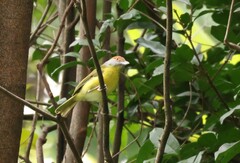
Rufous-browed Peppershrike

Rufous-browed Peppershrike

Cyclarhis gujanensis

Silhouette: Sheatherius · PhyloPic

LCLeast ConcernNTVUENCR
Daily sighting probability ~40% · Likely
at Goiânia

In 3 days ~80% in a week >90%

228 Verified sightings at Goiânia
12,636 In all 52 parks From 2019 to 2026
January Best month
☀️ Diurnal When it's spotted

About the Rufous-browed Peppershrike

The rufous-browed peppershrike (Cyclarhis gujanensis) is a passerine bird in the vireo family. It is widespread and often common in woodland, forest edge, and cultivation with some tall trees from Mexico and Trinidad south to Argentina and Uruguay.

The rufous-browed peppershrike was formally described in 1789 by the German naturalist Johann Friedrich Gmelin in his revised and expanded edition of Carl Linnaeus's Systema Naturae. He placed it in the genus Tanagra and coined the binomial name Tanagra gujanensis. The specific epithet is derived from the type locality, the Guianas. Gmelin based his account on "Le verderoux" from French Guiana that had been described in 1778 by the French polymath Comte de Buffon in his multivolume Histoire Naturelle des Oiseaux. The rufous-browed peppershrike is now placed with the black-billed peppershrike in the genus Cyclarhis that was introduced in 1824 by William Swainson.

Twenty two subspecies are recognised: Wikipedia →

Sounds

Song0:44

French Guiana · 2024

© Tristan Guillebot de Nerville · XC1152503 · CC BY-NC-SA 4.0

Call0:13

Brazil · 2026

© JAYRSON ARAUJO DE OLIVEIRA · XC1149539 · CC BY-NC-SA 4.0

Recording0:28

Paraguay · 2026

© Guillermo Menéndez (gmmv80) · XC1072367 · CC BY-NC-SA 4.0

Global Distribution

Parks Where Found

# Park Country Daily sighting probability
1 El Impenetrable National Park 🇦🇷 Argentina
~60%
2 Itatiaia National Park 🇧🇷 Brazil
~50%
3 Arrecifes de Cozumel National Park 🇲🇽 Mexico
~40%
4 Serra dos Órgãos National Park 🇧🇷 Brazil
~30%
5 Caroni Swamp 🇹🇹 Trinidad and Tobago
~30%
6 Sian Ka'an Biosphere Reserve 🇲🇽 Mexico
~30%
7 El Triunfo 🇲🇽 Mexico
~30%
8 Chapada dos Guimarães National Park 🇧🇷 Brazil
~30%
9 Henri Pittier National Park 🇻🇪 Venezuela
~30%
10 Volcán Barú National Park 🇵🇦 Panama
~30%
11 Cañón del Sumidero National Park 🇲🇽 Mexico
~30%
12 Iberá National Park 🇦🇷 Argentina
~30%
13 Chapada Diamantina National Park 🇧🇷 Brazil
~20%
14 Cerro Azul Meámbar National Park 🇭🇳 Honduras
~20%
15 Celaque National Park 🇭🇳 Honduras
~20%
16 El Palmar National Park 🇦🇷 Argentina
~20%
17 La Tigra National Park 🇭🇳 Honduras
~20%
18 Coiba National Park 🇵🇦 Panama
~20%
19 Irazú Volcano National Park 🇨🇷 Costa Rica
~10%
20 Los Quetzales National Park 🇨🇷 Costa Rica
~10%
21 Calakmul Biosphere Reserve 🇲🇽 Mexico
~10%
22 Parque Estadual Encontro das Águas 🇧🇷 Brazil
~10%
23 La Amistad International Park (Panama) 🇵🇦 Panama
~10%
24 Celestún Biosphere Reserve 🇲🇽 Mexico
~10%
25 Iguazú National Park 🇦🇷 Argentina
~10%
26 Chirripó National Park 🇨🇷 Costa Rica
~10%
27 Machalilla National Park 🇪🇨 Ecuador
~10%
28 Tapantí-Macizo de la Muerte National Park 🇨🇷 Costa Rica
~10%
29 Podocarpus National Park 🇪🇨 Ecuador
~10%
30 Anavilhanas National Park 🇧🇷 Brazil
~10%
31 Lago de Yojoa 🇭🇳 Honduras
~10%
32 Carara National Park 🇨🇷 Costa Rica
~10%
33 Iguaçu National Park 🇧🇷 Brazil
~10%
34 Monteverde Cloud Forest Reserve 🇨🇷 Costa Rica
~10%
35 Tijuca National Park 🇧🇷 Brazil
~10%
36 Amboró National Park 🇧🇴 Bolivia
~10%
37 Sierra de la Macarena National Park 🇨🇴 Colombia
~10%
38 Emas National Park 🇧🇷 Brazil
<5%
39 Tayrona National Natural Park 🇨🇴 Colombia
<5%
40 Ría Lagartos Biosphere Reserve 🇲🇽 Mexico
<5%
41 Braulio Carrillo National Park 🇨🇷 Costa Rica
<5%
42 Serra da Canastra National Park 🇧🇷 Brazil
<5%
43 Santa Rosa National Park 🇨🇷 Costa Rica
<5%
44 Palo Verde National Park 🇨🇷 Costa Rica
<5%
45 Cabo Blanco Absolute Nature Reserve 🇨🇷 Costa Rica
<5%
46 Poás Volcano National Park 🇨🇷 Costa Rica
<5%
47 Arenal Volcano National Park 🇨🇷 Costa Rica
<5%
48 Masaya Volcano National Park 🇳🇮 Nicaragua
<5%
49 Tambopata National Reserve 🇵🇪 Peru
<5%
50 Los Nevados National Natural Park 🇨🇴 Colombia
<5%
51 Parque Natural Metropolitano 🇵🇦 Panama
<5%
52 Manu National Park 🇵🇪 Peru
<5%

Cities Where Found

# City Country Daily sighting probability
1 Fortaleza 🇧🇷 Brazil
~50%
2 Brasilia 🇧🇷 Brazil
~50%
3 Natal 🇧🇷 Brazil
~50%
4 Asuncion 🇵🇾 Paraguay
~40%
5 Goiânia 🇧🇷 Brazil
~40%
6 Curitiba 🇧🇷 Brazil
~40%
7 Campo Grande 🇧🇷 Brazil
~40%
8 São Paulo 🇧🇷 Brazil
~40%
9 Recife 🇧🇷 Brazil
~30%
10 Caracas 🇻🇪 Venezuela
~30%

Before you go

What are the chances of seeing a Rufous-browed Peppershrike in Goiânia?

Likely

About 40% of wildlife watchers report a Rufous-browed Peppershrike sighting in Goiânia on a given day, based on 228 verified sightings from GBIF citizen-science data. It is the 20th most-seen of the 174 birds we can rate there. Over three days the chance rises to about 80%, and over a week to over 90%, if each day is a fresh chance.

When is the best time to see a Rufous-browed Peppershrike in Goiânia?

January and November

In those months about 60% of wildlife watchers report a Rufous-browed Peppershrike in Goiânia on a given day, against about 20% in May, July and December, the lowest months. Those are among Goiânia's wettest months, with about 220 mm of rain a month against almost none in July.

What time of day is best to see a Rufous-browed Peppershrike?

Between 8 and 11 am

Across all the parks we cover, that three-hour window holds the most Rufous-browed Peppershrike sightings with a recorded time, and about 9 in 10 of them come between 6 am and 6 pm: it is a daytime animal.

Is Goiânia the best place to see a Rufous-browed Peppershrike?

5th of 35

Of the 35 cities where we can rate Rufous-browed Peppershrike sightings, Goiânia ranks 5th at about 40%. The best odds are in Fortaleza (Brazil, about 50%), Brasilia (Brazil, about 50%) and Natal (Brazil, about 50%).

Where does the Rufous-browed Peppershrike sighting chance come from?

GBIF citizen-science records

It is estimated from how often the Rufous-browed Peppershrike is recorded against all the birds logged in Goiânia (228 verified sightings), calibrated against known sighting rates. Figures are rounded to the nearest 10% because citizen-science data supports honest approximations, not decimals, and months with records from fewer than five people show "—". How it works.

← Back to Goiânia