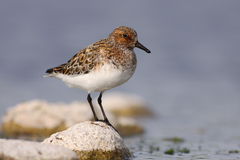
Sanderling

Sanderling

Calidris alba

Silhouette: Caleb M. Gordon · PhyloPic

LCLeast ConcernNTVUENCR
Daily sighting probability <5% · Rare
at Nagoya

In 3 days ~10%

70 Verified sightings at Nagoya
17,905 In all 65 parks From 2019 to 2026
November Best month
☀️ Diurnal When it's spotted

About the Sanderling

The sanderling (Calidris alba) is a small wading bird. It is a circumpolar Arctic breeder, being among the most extreme northern breeding birds in the world, nesting only on the coldest tundra, north of the 5°C July isotherm; in Europe, its southernmost breeding locality is Svalbard, where only a handful (5–15) pairs breed. It is a long-distance migrant, wintering south to South America, western and southern Europe, Africa, and Australia. It is highly gregarious in winter, sometimes forming large flocks on coastal mudflats or sandy beaches.

It is somewhat unlike other small sandpipers in appearance, in particular in lacking a hind toe, which has led to the suggestion that it should be placed into a monotypic genus Crocethia. More recent reviews indicate that the sanderling is a fairly typical "stint" or small sandpiper and should be retained along with the knots and other relatives in the genus Calidris.

This bird is similar in size to a dunlin, but stouter, with a thick bill. It shows a strong white wingbar in flight, and runs along the sandy beaches it prefers with a characteristic "bicycling" action of its legs, stopping frequently to pick small food items. It eats small crabs and other small invertebrates. In spring, birds migrating north from South America consume large numbers of horseshoe crab eggs in the Delaware Bay area.

In spring, the birds arrive on their High Arctic breeding grounds (see map) at the end of May or in early June, where they lay 3–4 eggs in a ground scrape from mid June to mid July. On the nesting grounds, these birds mainly eat insects and some plant material.

The sanderling was described by the German naturalist Peter Simon Pallas in 1764 and given the binomial name Trynga alba. The sanderling is one of the species to which the Agreement on the Conservation of African-Eurasian Migratory Waterbirds (AEWA) applies. Wikipedia →

Sounds

Flight call0:07

Netherlands · 2026

© Daan van der Hoeven · XC1183321 · CC BY-NC-SA 4.0

Nocturnal flight call0:19

France · 2026

© Bodhuin Maxime · XC1157864 · CC BY-NC-SA 4.0

Call0:12

France · 2025

© Lionel FREDERIC · XC1030106 · CC BY-NC-SA 4.0

Global Distribution

Parks Where Found

# Park Country Daily sighting probability
1 Padre Island National Seashore 🇺🇸 United States
~80%
2 Ría Lagartos Biosphere Reserve 🇲🇽 Mexico
~40%
3 West Coast National Park 🇿🇦 South Africa
~40%
4 Isla del Coco National Park 🇨🇷 Costa Rica
~30%
5 Rottnest Island 🇦🇺 Australia
~20%
6 Merritt Island National Wildlife Refuge 🇺🇸 United States
~20%
7 Pacific Rim National Park Reserve 🇨🇦 Canada
~20%
8 Doñana National Park 🇪🇸 Spain
~20%
9 Wadden Sea National Park 🇩🇪 Germany
~20%
10 Channel Islands National Park 🇺🇸 United States
~20%
11 Celestún Biosphere Reserve 🇲🇽 Mexico
~20%
12 iSimangaliso Wetland Park 🇿🇦 South Africa
~10%
13 Bahía de Loreto National Park 🇲🇽 Mexico
~10%
14 Arrecifes de Cozumel National Park 🇲🇽 Mexico
~10%
15 Tortuguero National Park 🇨🇷 Costa Rica
~10%
16 Galápagos Islands 🇪🇨 Ecuador
~10%
17 Point Pelee National Park 🇨🇦 Canada
~10%
18 El Vizcaíno Biosphere Reserve 🇲🇽 Mexico
~10%
19 Ostional Wildlife Refuge 🇨🇷 Costa Rica
~10%
20 Cape Range 🇦🇺 Australia
~10%
21 Bastimentos Island National Marine Park 🇵🇦 Panama
~10%
22 Coiba National Park 🇵🇦 Panama
~10%
23 Ningaloo Marine Park 🇦🇺 Australia
~10%
24 Carara National Park 🇨🇷 Costa Rica
~10%
25 Cabo Blanco Absolute Nature Reserve 🇨🇷 Costa Rica
~10%
26 Península Valdés 🇦🇷 Argentina
~10%
27 Gandoca-Manzanillo Wildlife Refuge 🇨🇷 Costa Rica
<5%
28 Sian Ka'an Biosphere Reserve 🇲🇽 Mexico
<5%
29 Jaragua National Park 🇩🇴 Dominican Republic
<5%
30 Riding Mountain National Park 🇨🇦 Canada
<5%
31 Svalbard 🇳🇴 Norway
<5%
32 Vatnajokull National Park 🇮🇸 Iceland
<5%
33 Camargue 🇫🇷 France
<5%
34 Marino Ballena National Park 🇨🇷 Costa Rica
<5%
35 Las Baulas Marine National Park 🇨🇷 Costa Rica
<5%
36 Everglades National Park 🇺🇸 United States
<5%
37 Snowdonia National Park 🇬🇧 United Kingdom
<5%
38 Namib-Naukluft National Park 🇳🇦 Namibia
<5%
39 Bali Barat National Park 🇮🇩 Indonesia
<5%
40 Machalilla National Park 🇪🇨 Ecuador
<5%
41 Olympic National Park 🇺🇸 United States
<5%
42 La Amistad International Park (Panama) 🇵🇦 Panama
<5%
43 Gros Morne National Park 🇨🇦 Canada
<5%
44 Redwood National Park 🇺🇸 United States
<5%
45 Cahuita National Park 🇨🇷 Costa Rica
<5%
46 Great Bear Rainforest 🇨🇦 Canada
<5%
47 Addo Elephant National Park 🇿🇦 South Africa
<5%
48 Wilsons Promontory National Park 🇦🇺 Australia
<5%
49 Cape Breton Highlands National Park 🇨🇦 Canada
<5%
50 Los Haitises National Park 🇩🇴 Dominican Republic
<5%
51 Table Mountain National Park 🇿🇦 South Africa
<5%
52 Tayrona National Natural Park 🇨🇴 Colombia
<5%
53 Yala National Park 🇱🇰 Sri Lanka
<5%
54 Santa Rosa National Park 🇨🇷 Costa Rica
<5%
55 Ciénaga de Zapata 🇨🇺 Cuba
<5%
56 Big Cypress National Preserve 🇺🇸 United States
<5%
57 Acadia National Park 🇺🇸 United States
<5%
58 Corcovado National Park 🇨🇷 Costa Rica
<5%
59 Sierra de Guadarrama National Park 🇪🇸 Spain
<5%
60 Piedras Blancas National Park 🇨🇷 Costa Rica
<5%
61 Amboseli National Park 🇰🇪 Kenya
<5%
62 Garden Route National Park 🇿🇦 South Africa
<5%
63 Fertő-Hanság National Park 🇭🇺 Hungary
<5%
64 Manuel Antonio National Park 🇨🇷 Costa Rica
<5%
65 Palo Verde National Park 🇨🇷 Costa Rica
<5%

Cities Where Found

# City Country Daily sighting probability
1 Casablanca 🇲🇦 Morocco
~20%
2 Maputo 🇲🇿 Mozambique
~20%
3 Havana 🇨🇺 Cuba
~20%
4 Porto 🇵🇹 Portugal
~10%
5 São Luís 🇧🇷 Brazil
~10%
6 Kozhikode 🇮🇳 India
~10%
7 Kuwait City 🇰🇼 Kuwait
~10%
8 Kollam 🇮🇳 India
~10%
9 Miami 🇺🇸 United States
~10%
10 Dublin 🇮🇪 Ireland
~10%

Zoos & Centres Where Found

# Zoo / Centre Country
1 National Zoological Park 🇺🇸 United States In captivity
2 Monterey Bay Aquarium 🇺🇸 United States In captivity

Before you go

What are the chances of seeing a Sanderling in Nagoya?

Rare

Under 5% of wildlife watchers report a Sanderling sighting in Nagoya on a given day, based on 70 verified sightings from GBIF citizen-science data. It is the 84th most-seen of the 165 birds we can rate there. Over three days the chance rises to about 10%, if each day is a fresh chance.

When is the best time to see a Sanderling in Nagoya?

November

In that month about 10% of wildlife watchers report a Sanderling in Nagoya on a given day, against under 5% in December to October, the lowest months.

What time of day is best to see a Sanderling?

Between 10 am and 1 pm

Across all the parks we cover, that three-hour window holds the most Sanderling sightings with a recorded time, and about 9 in 10 of them come between 6 am and 6 pm: it is a daytime animal.

Is Nagoya the best place to see a Sanderling?

27th of 55

Of the 55 cities where we can rate Sanderling sightings, Nagoya ranks 27th at under 5%. The best odds are in Casablanca (Morocco, about 20%), Maputo (Mozambique, about 20%) and Havana (Cuba, about 20%).

Where does the Sanderling sighting chance come from?

GBIF citizen-science records

It is estimated from how often the Sanderling is recorded against all the birds logged in Nagoya (70 verified sightings), calibrated against known sighting rates. Figures are rounded to the nearest 10% because citizen-science data supports honest approximations, not decimals, and months with records from fewer than five people show "—". How it works.

← Back to Nagoya