Green Sandpiper

Green Sandpiper

Tringa ochropus

Silhouette: Andy Wilson · PhyloPic

LCLeast ConcernNTVUENCR
Daily sighting probability ~10% · With luck
at Kiskunság National Park

In 3 days ~30% in a week ~60%

111 Verified sightings at Kiskunság National Park From 2019 to 2026
10,729 In all 70 parks
March Best month
☀️ Diurnal When it's spotted

About the Green Sandpiper

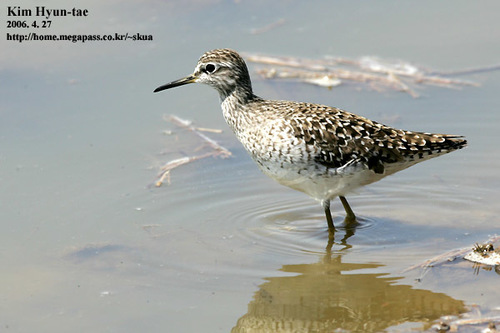
The green sandpiper (Tringa ochropus) is a small wader (shorebird) of the Old World. The green sandpiper represents an ancient lineage of the genus Tringa; its only close living relative is the solitary sandpiper (T. solitaria). They both have brown wings with little light dots and a delicate but contrasting neck and chest pattern. In addition, both species nest in trees, unlike most other scolopacids.

Given its basal position in Tringa, it is fairly unsurprising that suspected cases of hybridisation between this species and the common sandpiper (A. hypoleucos) of the sister genus Actitis have been reported. The green sandpiper was formally described by the Swedish naturalist Carl Linnaeus in 1758 in the tenth edition of his Systema Naturae under the current binomial name Tringa ochropus. The genus name Tringa is the Neo-Latin name given to the green sandpiper by Aldrovandus in 1599 based on Ancient Greek trungas, a thrush-sized, white-rumped, tail-bobbing wading bird mentioned by Aristotle. The specific ochropus is from Ancient Greek okhros, "ochre", and pous, "foot". The species is monotypic: no subspecies are recognised.

This species is a somewhat... Wikipedia →

Sounds

Call0:08

France · 2026

© Sébastien Reeber · XC1185105 · CC BY-NC-SA 4.0

Alarm call0:59

Sweden · 2026

© Lars Edenius · XC1143433 · CC BY-NC-SA 4.0

Song0:24

Sweden · 2022

© Marc Anderson · XC1079358 · CC BY-NC-ND 4.0

Global Distribution

Parks Where Found

# Park Country Daily sighting probability
1 Bale Mountains National Park 🇪🇹 Ethiopia
~50%
2 Keoladeo National Park 🇮🇳 India
~40%
3 Kaziranga National Park 🇮🇳 India
~40%
4 Ranthambore National Park 🇮🇳 India
~30%
5 Camargue 🇫🇷 France
~30%
6 Doñana National Park 🇪🇸 Spain
~30%
7 Chitwan National Park 🇳🇵 Nepal
~30%
8 Royal Bardia National Park 🇳🇵 Nepal
~30%
9 Niokolo-Koba National Park 🇸🇳 Senegal
~30%
10 Nairobi National Park 🇰🇪 Kenya
~20%
11 Kanha National Park 🇮🇳 India
~20%
12 Bandhavgarh National Park 🇮🇳 India
~20%
13 Manas National Park 🇮🇳 India
~10%
14 Kidepo Valley National Park 🇺🇬 Uganda
~10%
15 Jim Corbett National Park 🇮🇳 India
~10%
16 Białowieża National Park 🇵🇱 Poland
~10%
17 Liwonde National Park 🇲🇼 Malawi
~10%
18 Meru National Park 🇰🇪 Kenya
~10%
19 Kiskunság National Park 🇭🇺 Hungary
~10%
20 Arusha National Park 🇹🇿 Tanzania
~10%
21 Masai Mara National Reserve 🇰🇪 Kenya
~10%
22 Biebrza National Park 🇵🇱 Poland
~10%
23 Monfragüe National Park 🇪🇸 Spain
~10%
24 Samburu National Reserve 🇰🇪 Kenya
~10%
25 Lake Nakuru National Park 🇰🇪 Kenya
~10%
26 Satpura National Park 🇮🇳 India
~10%
27 Gir National Park 🇮🇳 India
~10%
28 Hortobágy National Park 🇭🇺 Hungary
~10%
29 Tarangire National Park 🇹🇿 Tanzania
~10%
30 Aberdare National Park 🇰🇪 Kenya
~10%
31 Lake Mburo National Park 🇺🇬 Uganda
~10%
32 Akagera National Park 🇷🇼 Rwanda
~10%
33 Yala National Park 🇱🇰 Sri Lanka
~10%
34 Tsavo West National Park 🇰🇪 Kenya
~10%
35 Semuliki National Park 🇺🇬 Uganda
~10%
36 Nagarhole National Park 🇮🇳 India
~10%
37 Tsavo East National Park 🇰🇪 Kenya
~10%
38 Sierra de Guadarrama National Park 🇪🇸 Spain
~10%
39 Ruaha National Park 🇹🇿 Tanzania
~10%
40 Fertő-Hanság National Park 🇭🇺 Hungary
~10%
41 Serengeti National Park 🇹🇿 Tanzania
~10%
42 Amboseli National Park 🇰🇪 Kenya
~10%
43 Namdapha National Park 🇮🇳 India
~10%
44 Mercantour National Park 🇫🇷 France
~10%
45 Gobi Gurvansaikhan National Park 🇲🇳 Mongolia
~10%
46 Wadden Sea National Park 🇩🇪 Germany
~10%
47 Awash National Park 🇪🇹 Ethiopia
~10%
48 Mikumi National Park 🇹🇿 Tanzania
<5%
49 Lake Manyara National Park 🇹🇿 Tanzania
<5%
50 Periyar National Park 🇮🇳 India
<5%
51 Bandipur National Park 🇮🇳 India
<5%
52 Wilpattu National Park 🇱🇰 Sri Lanka
<5%
53 Mudumalai National Park 🇮🇳 India
<5%
54 Udawalawe National Park 🇱🇰 Sri Lanka
<5%
55 Murchison Falls National Park 🇺🇬 Uganda
<5%
56 Mkomazi National Park 🇹🇿 Tanzania
<5%
57 Ngorongoro Conservation Area 🇹🇿 Tanzania
<5%
58 Bavarian Forest National Park 🇩🇪 Germany
<5%
59 Queen Elizabeth National Park 🇺🇬 Uganda
<5%
60 Sierra Nevada National Park 🇪🇸 Spain
<5%
61 Aigüestortes National Park 🇪🇸 Spain
<5%
62 Sundarbans National Park 🇮🇳 India
<5%
63 Gauja National Park 🇱🇻 Latvia
<5%
64 Picos de Europa National Park 🇪🇸 Spain
<5%
65 Bali Barat National Park 🇮🇩 Indonesia
<5%
66 Snowdonia National Park 🇬🇧 United Kingdom
<5%
67 Royal Manas National Park 🇧🇹 Bhutan
<5%
68 Pyrénées National Park 🇫🇷 France
<5%
69 Doi Inthanon National Park 🇹🇭 Thailand
<5%
70 Kruger National Park 🇿🇦 South Africa
<5%

Cities Where Found

# City Country Daily sighting probability
1 Vasai-Virar 🇮🇳 India
~30%
2 Xi'an 🇨🇳 China
~20%
3 Kathmandu 🇳🇵 Nepal
~20%
4 Agra 🇮🇳 India
~20%
5 Karachi 🇵🇰 Pakistan
~20%
6 Lucknow 🇮🇳 India
~20%
7 Indore 🇮🇳 India
~20%
8 Tashkent 🇺🇿 Uzbekistan
~20%
9 Nanchang 🇨🇳 China
~20%
10 Rabat 🇲🇦 Morocco
~10%

Before you go

What are the chances of seeing a Green Sandpiper in Kiskunság National Park?

With luck

About 10% of wildlife watchers report a Green Sandpiper sighting in Kiskunság National Park on a given day, based on 111 verified sightings from GBIF citizen-science data from 2019 to 2026. It is the 122nd most-seen of the 222 birds we can rate there. Over three days the chance rises to about 30%, and over a week to about 60%, if each day is a fresh chance.

When is the best time to see a Green Sandpiper in Kiskunság National Park?

March

In that month about 30% of wildlife watchers report a Green Sandpiper in Kiskunság National Park on a given day, against under 5% in May and November–February, the lowest months.

What time of day is best to see a Green Sandpiper?

Between 9 am and noon

Across all the parks we cover, that three-hour window holds the most Green Sandpiper sightings with a recorded time, and about 9 in 10 of them come between 6 am and 6 pm: it is a daytime animal.

Which relatives of the Green Sandpiper live in Kiskunság National Park?

Same genus: Tringa

The closest relatives of the Green Sandpiper that you can see in Kiskunság National Park (genus Tringa, Shanks, Tattlers, and Allies) are Common Redshank (about 30%), Wood Sandpiper (about 20%) and Spotted Redshank (about 20%), with each one's daily chance of a sighting.

Where does the Green Sandpiper sighting chance come from?

GBIF citizen-science records

It is estimated from how often the Green Sandpiper is recorded against all the birds logged in Kiskunság National Park (111 verified sightings from 2019 to 2026), calibrated against known sighting rates. Figures are rounded to the nearest 10% because citizen-science data supports honest approximations, not decimals, and months with records from fewer than five people show "—". How it works.

← Back to Kiskunság National Park