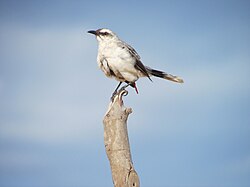
Tropical Mockingbird

Tropical Mockingbird

Mimus gilvus

Silhouette: Anna Delesmillieres, Titouan Montessuit · PhyloPic

LCLeast ConcernNTVUENCR
Daily sighting probability <5% · Rare
at Santa Rosa National Park

In 3 days <5% in a week ~10%

9 Verified sightings at Santa Rosa National Park From 2019 to 2026
22,575 In all 50 parks
April Best month
☀️ Diurnal When it's spotted

About the Tropical Mockingbird

The tropical mockingbird (Mimus gilvus) is a resident breeding bird from southern Mexico to northern and eastern South America and in the Lesser Antilles and other Caribbean islands. The tropical mockingbird has sometimes been considered conspecific with its closest living relative, the northern mockingbird (Milvus polyglottos) and forms a superspecies with it. The critically endangered Socorro mockingbird (M. graysoni) is also much closer to these two than previously believed.

The tropical mockingbird has these ten subspecies: Adult tropical mockingbirds are 23 to 25.5 cm (9.1 to 10.0 in) long. The mean weights of various subspecies vary greatly. Adults of the nominate subspecies... Wikipedia →

Sounds

Call0:54

Ecuador · 2025

© Manuel Sánchez-Nivicela · XC1106655 · CC BY-NC-ND 4.0

Song0:13

France · 2022

© Denis Dujardin · XC1056115 · CC BY-NC-SA 4.0

Song phrases0:51

Guyana · 2025

© Richard E. Webster · XC1032105 · CC BY-NC-SA 4.0

Global Distribution

Parks Where Found

# Park Country Daily sighting probability
1 Arrecifes de Cozumel National Park 🇲🇽 Mexico
~90%
2 Sian Ka'an Biosphere Reserve 🇲🇽 Mexico
~70%
3 Main Ridge Forest Reserve 🇹🇹 Trinidad and Tobago
~70%
4 Celestún Biosphere Reserve 🇲🇽 Mexico
~70%
5 San Lorenzo Protected Forest 🇵🇦 Panama
~40%
6 Caroni Swamp 🇹🇹 Trinidad and Tobago
~40%
7 Ría Lagartos Biosphere Reserve 🇲🇽 Mexico
~40%
8 Soberanía National Park 🇵🇦 Panama
~30%
9 Marino Ballena National Park 🇨🇷 Costa Rica
~30%
10 Volcán Barú National Park 🇵🇦 Panama
~30%
11 Chirripó National Park 🇨🇷 Costa Rica
~20%
12 Sierra de la Macarena National Park 🇨🇴 Colombia
~20%
13 Parque Natural Metropolitano 🇵🇦 Panama
~20%
14 Henri Pittier National Park 🇻🇪 Venezuela
~20%
15 Masaya Volcano National Park 🇳🇮 Nicaragua
~20%
16 Los Quetzales National Park 🇨🇷 Costa Rica
~20%
17 La Amistad International Park (Panama) 🇵🇦 Panama
~20%
18 Piedras Blancas National Park 🇨🇷 Costa Rica
~20%
19 Braulio Carrillo National Park 🇨🇷 Costa Rica
~10%
20 Chagres National Park 🇵🇦 Panama
~10%
21 Irazú Volcano National Park 🇨🇷 Costa Rica
~10%
22 Calakmul Biosphere Reserve 🇲🇽 Mexico
~10%
23 Rincón de la Vieja National Park 🇨🇷 Costa Rica
~10%
24 Arenal Volcano National Park 🇨🇷 Costa Rica
~10%
25 Coiba National Park 🇵🇦 Panama
~10%
26 Tenorio Volcano National Park 🇨🇷 Costa Rica
~10%
27 Cahuita National Park 🇨🇷 Costa Rica
~10%
28 Utría National Natural Park 🇨🇴 Colombia
~10%
29 Farallones de Cali National Natural Park 🇨🇴 Colombia
~10%
30 Manuel Antonio National Park 🇨🇷 Costa Rica
~10%
31 Tortuguero National Park 🇨🇷 Costa Rica
~10%
32 Las Baulas Marine National Park 🇨🇷 Costa Rica
~10%
33 Los Nevados National Natural Park 🇨🇴 Colombia
~10%
34 Gandoca-Manzanillo Wildlife Refuge 🇨🇷 Costa Rica
~10%
35 Cerro Azul Meámbar National Park 🇭🇳 Honduras
<5%
36 Poás Volcano National Park 🇨🇷 Costa Rica
<5%
37 Tayrona National Natural Park 🇨🇴 Colombia
<5%
38 Chingaza National Natural Park 🇨🇴 Colombia
<5%
39 Tapantí-Macizo de la Muerte National Park 🇨🇷 Costa Rica
<5%
40 Brownsberg Nature Park 🇸🇷 Suriname
<5%
41 Cañón del Sumidero National Park 🇲🇽 Mexico
<5%
42 Palo Verde National Park 🇨🇷 Costa Rica
<5%
43 Cockscomb Basin Wildlife Sanctuary 🇧🇿 Belize
<5%
44 Santa Rosa National Park 🇨🇷 Costa Rica
<5%
45 Corcovado National Park 🇨🇷 Costa Rica
<5%
46 Carara National Park 🇨🇷 Costa Rica
<5%
47 Bastimentos Island National Marine Park 🇵🇦 Panama
<5%
48 Cuyabeno Wildlife Reserve 🇪🇨 Ecuador
<5%
49 Yasuní National Park 🇪🇨 Ecuador
<5%
50 Monteverde Cloud Forest Reserve 🇨🇷 Costa Rica
<5%

Cities Where Found

# City Country Daily sighting probability
1 Maracaibo 🇻🇪 Venezuela
~90%
2 Salvador 🇧🇷 Brazil
~40%
3 Bogota 🇨🇴 Colombia
~40%
4 Caracas 🇻🇪 Venezuela
~40%
5 Panama City 🇵🇦 Panama
~40%
6 San Pedro Sula 🇭🇳 Honduras
~30%
7 Valencia 🇻🇪 Venezuela
~30%
8 Quito 🇪🇨 Ecuador
~30%
9 Vitória 🇧🇷 Brazil
~20%
10 San José 🇨🇷 Costa Rica
~20%

Before you go

What are the chances of seeing a Tropical Mockingbird in Santa Rosa National Park?

Rare

Under 5% of wildlife watchers report a Tropical Mockingbird sighting in Santa Rosa National Park on a given day, based on 9 verified sightings from GBIF citizen-science data from 2019 to 2026. It is the 198th most-seen of the 233 birds we can rate there. Over three days the chance rises to under 5%, and over a week to about 10%, if each day is a fresh chance.

When is the best time to see a Tropical Mockingbird in Santa Rosa National Park?

April

In that month about 10% of wildlife watchers report a Tropical Mockingbird in Santa Rosa National Park on a given day, against under 5% in May to March, the lowest months. That is one of Santa Rosa National Park's driest months, with about 35 mm of rain against 450 mm in October.

What time of day is best to see a Tropical Mockingbird?

Between 3 and 6 pm

Across all the parks we cover, that three-hour window holds the most Tropical Mockingbird sightings with a recorded time, and about 9 in 10 of them come between 6 am and 6 pm: it is a daytime animal.

Which relatives of the Tropical Mockingbird live in Santa Rosa National Park?

Same order: Passeriformes

The closest relatives of the Tropical Mockingbird that you can see in Santa Rosa National Park (order Passeriformes, Perching Birds) are Banded Wren (about 60%), Rufous-capped Warbler (about 50%) and Great Kiskadee (about 50%), with each one's daily chance of a sighting.

Where does the Tropical Mockingbird sighting chance come from?

GBIF citizen-science records

It is estimated from how often the Tropical Mockingbird is recorded against all the birds logged in Santa Rosa National Park (9 verified sightings from 2019 to 2026), calibrated against known sighting rates. Figures are rounded to the nearest 10% because citizen-science data supports honest approximations, not decimals, and months with records from fewer than five people show "—". How it works.

← Back to Santa Rosa National Park