Blue Dacnis

Blue Dacnis

Dacnis cayana

Silhouette: Sheatherius · PhyloPic

LCLeast ConcernNTVUENCR
Daily sighting probability <5% · Rare
at Porto Alegre

In 3 days <5%

10 Verified sightings at Porto Alegre
18,618 In all 44 parks From 2019 to 2026
June Best month
☀️ Diurnal When it's spotted

About the Blue Dacnis

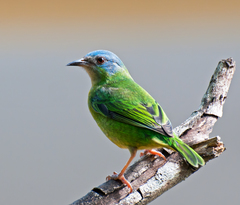
The blue dacnis or turquoise honeycreeper (Dacnis cayana) is a small passerine bird in the family Thraupidae, the tanagers and allies. It is found in Central America from Honduras to Panama, on Trinidad, and in every mainland South American country except Chile and Uruguay.

In 1760, the French zoologist Mathurin Jacques Brisson included a description of the blue dacnis in his Ornithologie based on a specimen collected in "Cayenne" (French Guiana). He used the French name Le Pepit bleu de Cayenne and the Latin name Sylvia cayanensis caerulea. Although Brisson coined Latin names, these do not conform to the binomial system and are not recognized by the International Commission on Zoological Nomenclature. When in 1766 the Swedish naturalist Carl Linnaeus updated his Systema Naturae for the twelfth edition he added 240 species that had been previously described by Brisson. One of these was the blue dacnis. Linnaeus included a terse description, coined the binomial Motacilla cayana and cited Brisson's work. The specific epithet cayana is from Cayenne. This species is now placed in the genus Dacnis that was introduced in 1816 by the French naturalist Georges Cuvier with the... Wikipedia →

Sounds

Call0:15

Brazil · 2026

© JAYRSON ARAUJO DE OLIVEIRA · XC1135581 · CC BY-NC-SA 4.0

Song0:08

Costa Rica · 2021

© Johan Chaves · XC679699 · CC BY-NC-SA 4.0

Call0:14

Brazil · 2023

© Luiz C. Silva · XC828497 · CC BY-NC-SA 4.0

Global Distribution

Parks Where Found

# Park Country Daily sighting probability
1 Serra dos Órgãos National Park 🇧🇷 Brazil
~60%
2 Chapada Diamantina National Park 🇧🇷 Brazil
~50%
3 Itatiaia National Park 🇧🇷 Brazil
~50%
4 Chapada dos Guimarães National Park 🇧🇷 Brazil
~50%
5 Soberanía National Park 🇵🇦 Panama
~40%
6 Iguazú National Park 🇦🇷 Argentina
~40%
7 Iguaçu National Park 🇧🇷 Brazil
~30%
8 Serra da Canastra National Park 🇧🇷 Brazil
~30%
9 Chagres National Park 🇵🇦 Panama
~30%
10 Brownsberg Nature Park 🇸🇷 Suriname
~30%
11 Sierra de la Macarena National Park 🇨🇴 Colombia
~30%
12 Darién National Park 🇵🇦 Panama
~20%
13 Amboró National Park 🇧🇴 Bolivia
~20%
14 Emas National Park 🇧🇷 Brazil
~20%
15 Bastimentos Island National Marine Park 🇵🇦 Panama
~20%
16 Tayrona National Natural Park 🇨🇴 Colombia
~10%
17 Parque Natural Metropolitano 🇵🇦 Panama
~10%
18 Yasuní National Park 🇪🇨 Ecuador
~10%
19 Tijuca National Park 🇧🇷 Brazil
~10%
20 San Lorenzo Protected Forest 🇵🇦 Panama
~10%
21 Manu National Park 🇵🇪 Peru
~10%
22 Corcovado National Park 🇨🇷 Costa Rica
~10%
23 Utría National Natural Park 🇨🇴 Colombia
~10%
24 Tambopata National Reserve 🇵🇪 Peru
~10%
25 Marino Ballena National Park 🇨🇷 Costa Rica
~10%
26 Podocarpus National Park 🇪🇨 Ecuador
~10%
27 La Amistad International Park (Panama) 🇵🇦 Panama
~10%
28 Piedras Blancas National Park 🇨🇷 Costa Rica
~10%
29 Anavilhanas National Park 🇧🇷 Brazil
~10%
30 Braulio Carrillo National Park 🇨🇷 Costa Rica
~10%
31 Farallones de Cali National Natural Park 🇨🇴 Colombia
~10%
32 Carara National Park 🇨🇷 Costa Rica
~10%
33 Gandoca-Manzanillo Wildlife Refuge 🇨🇷 Costa Rica
<5%
34 Manuel Antonio National Park 🇨🇷 Costa Rica
<5%
35 Cahuita National Park 🇨🇷 Costa Rica
<5%
36 Chirripó National Park 🇨🇷 Costa Rica
<5%
37 Cuyabeno Wildlife Reserve 🇪🇨 Ecuador
<5%
38 Arenal Volcano National Park 🇨🇷 Costa Rica
<5%
39 Tenorio Volcano National Park 🇨🇷 Costa Rica
<5%
40 Poás Volcano National Park 🇨🇷 Costa Rica
<5%
41 Tapantí-Macizo de la Muerte National Park 🇨🇷 Costa Rica
<5%
42 Monteverde Cloud Forest Reserve 🇨🇷 Costa Rica
<5%
43 Tortuguero National Park 🇨🇷 Costa Rica
<5%
44 Parque Estadual Encontro das Águas 🇧🇷 Brazil
<5%

Cities Where Found

# City Country Daily sighting probability
1 Fortaleza 🇧🇷 Brazil
~20%
2 João Pessoa 🇧🇷 Brazil
~20%
3 Campo Grande 🇧🇷 Brazil
~20%
4 Belo Horizonte 🇧🇷 Brazil
~10%
5 Rio de Janeiro 🇧🇷 Brazil
~10%
6 Santos 🇧🇷 Brazil
~10%
7 Maceió 🇧🇷 Brazil
~10%
8 Brasilia 🇧🇷 Brazil
~10%
9 Goiânia 🇧🇷 Brazil
~10%
10 Vitória 🇧🇷 Brazil
~10%

Zoos & Centres Where Found

# Zoo / Centre Country
1 California Academy of Sciences 🇺🇸 United States In captivity
2 Chester Zoo 🇬🇧 United Kingdom In captivity
3 Philadelphia Zoo 🇺🇸 United States In captivity
4 Key West Butterfly and Nature Conservatory 🇺🇸 United States In captivity

Before you go

What are the chances of seeing a Blue Dacnis in Porto Alegre?

Rare

Under 5% of wildlife watchers report a Blue Dacnis sighting in Porto Alegre on a given day, based on 10 verified sightings from GBIF citizen-science data. It is the 137th most-seen of the 159 birds we can rate there. Over three days the chance rises to under 5%, if each day is a fresh chance.

When is the best time to see a Blue Dacnis in Porto Alegre?

Any time of year

In every month with enough records, under 5% of wildlife watchers report a Blue Dacnis in Porto Alegre on a given day, so our monthly data shows no clear season.

What time of day is best to see a Blue Dacnis?

Between 9 am and noon

Across all the parks we cover, that three-hour window holds the most Blue Dacnis sightings with a recorded time, and about 9 in 10 of them come between 6 am and 6 pm: it is a daytime animal.

Is Porto Alegre the best place to see a Blue Dacnis?

17th of 17

Of the 17 cities where we can rate Blue Dacnis sightings, Porto Alegre ranks 17th at under 5%. The best odds are in Fortaleza (Brazil, about 20%), João Pessoa (Brazil, about 20%) and Campo Grande (Brazil, about 20%).

Which relatives of the Blue Dacnis live in Porto Alegre?

Same family: Thraupidae

The closest relatives of the Blue Dacnis that you can see in Porto Alegre (family Thraupidae, Tanagers and Allies) are Sayaca Tanager (about 80%), Bananaquit (about 80%) and Saffron Finch (about 40%), with each one's daily chance of a sighting.

Where does the Blue Dacnis sighting chance come from?

GBIF citizen-science records

It is estimated from how often the Blue Dacnis is recorded against all the birds logged in Porto Alegre (10 verified sightings), calibrated against known sighting rates. Figures are rounded to the nearest 10% because citizen-science data supports honest approximations, not decimals, and months with records from fewer than five people show "—". How it works.

← Back to Porto Alegre