Amazon Kingfisher

Amazon Kingfisher

Chloroceryle amazona

Silhouette: Steven Traver · PhyloPic

LCLeast ConcernNTVUENCR
Daily sighting probability ~60% · Likely
at Cuyabeno Wildlife Reserve

In 3 days ~90% in a week >90%

437 Verified sightings at Cuyabeno Wildlife Reserve From 2019 to 2026
12,673 In all 50 parks
October Best month
☀️ Diurnal When it's spotted

About the Amazon Kingfisher

The Amazon kingfisher (Chloroceryle amazona) is a species of "water kingfisher" in subfamily Cerylinae of family Alcedinidae. It is found in the lowlands of the American tropics from southern Mexico south through Central America to northern Argentina.

The first formal description of the Amazon kingfisher was by the English ornithologist John Latham in 1790 under the binomial name Alcedo amazona. The current genus Chloroceryle was erected by Johann Jakob Kaup in 1848. The species is monotypic.

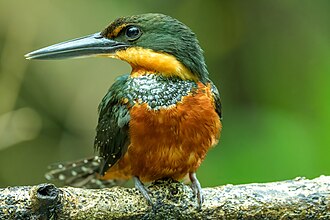
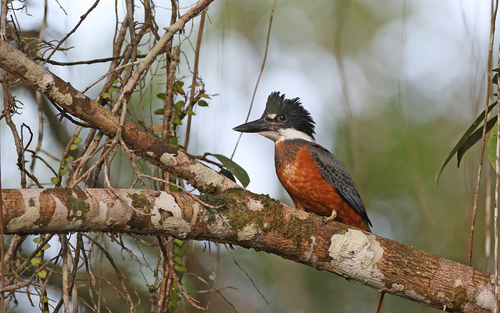
The Amazon kingfisher is about 30 cm (12 in) long. Males weigh 98 to 121 g (3.5 to 4.3 oz) and females 125 to 140 g (4.4 to 4.9 oz). It has the typical kingfisher shape, with a shaggy crest and long heavy bill. The bill is black with some pale yellow at the base of the mandible and its legs and feet are dark grey. Adult males have dark bronzy green upperparts divided by a white collar. They have a white chin and throat, a rich rufous breast with dark green sides, and a white belly with dark green streaks on the side. Adult females lack the rufous breast but the green of the sides extends across the breast almost to its middle. Juvenile males have... Wikipedia →

Sounds

Song0:08

Ecuador · 2026

© Manuel Sánchez-Nivicela · XC1182840 · CC BY-NC-ND 4.0

Flight call0:04

Brazil · 2026

© JAYRSON ARAUJO DE OLIVEIRA · XC1090537 · CC BY-NC-SA 4.0

Call0:24

Ecuador · 2025

© Marc Anderson · XC987184 · CC BY-NC-ND 4.0

Global Distribution

Parks Where Found

# Park Country Daily sighting probability
1 Parque Estadual Encontro das Águas 🇧🇷 Brazil
~70%
2 Cuyabeno Wildlife Reserve 🇪🇨 Ecuador
~60%
3 Tortuguero National Park 🇨🇷 Costa Rica
~40%
4 Anavilhanas National Park 🇧🇷 Brazil
~40%
5 Montes Azules Biosphere Reserve 🇲🇽 Mexico
~30%
6 Iberá National Park 🇦🇷 Argentina
~30%
7 Manu National Park 🇵🇪 Peru
~20%
8 Amacayacu National Natural Park 🇨🇴 Colombia
~20%
9 Carara National Park 🇨🇷 Costa Rica
~20%
10 Yasuní National Park 🇪🇨 Ecuador
~10%
11 Tambopata National Reserve 🇵🇪 Peru
~10%
12 Tayrona National Natural Park 🇨🇴 Colombia
~10%
13 Utría National Natural Park 🇨🇴 Colombia
~10%
14 Serra da Canastra National Park 🇧🇷 Brazil
~10%
15 Bastimentos Island National Marine Park 🇵🇦 Panama
~10%
16 El Impenetrable National Park 🇦🇷 Argentina
~10%
17 Palo Verde National Park 🇨🇷 Costa Rica
~10%
18 Iguaçu National Park 🇧🇷 Brazil
~10%
19 Sierra de la Macarena National Park 🇨🇴 Colombia
~10%
20 Iguazú National Park 🇦🇷 Argentina
~10%
21 Manuel Antonio National Park 🇨🇷 Costa Rica
~10%
22 Soberanía National Park 🇵🇦 Panama
~10%
23 Ostional Wildlife Refuge 🇨🇷 Costa Rica
~10%
24 Gandoca-Manzanillo Wildlife Refuge 🇨🇷 Costa Rica
~10%
25 Braulio Carrillo National Park 🇨🇷 Costa Rica
~10%
26 Henri Pittier National Park 🇻🇪 Venezuela
~10%
27 La Amistad International Park (Panama) 🇵🇦 Panama
~10%
28 Piedras Blancas National Park 🇨🇷 Costa Rica
~10%
29 Cockscomb Basin Wildlife Sanctuary 🇧🇿 Belize
<5%
30 Lago de Yojoa 🇭🇳 Honduras
<5%
31 Corcovado National Park 🇨🇷 Costa Rica
<5%
32 Marino Ballena National Park 🇨🇷 Costa Rica
<5%
33 Arenal Volcano National Park 🇨🇷 Costa Rica
<5%
34 Serra dos Órgãos National Park 🇧🇷 Brazil
<5%
35 Coiba National Park 🇵🇦 Panama
<5%
36 Darién National Park 🇵🇦 Panama
<5%
37 Cerro Azul Meámbar National Park 🇭🇳 Honduras
<5%
38 Pico Bonito National Park 🇭🇳 Honduras
<5%
39 Las Baulas Marine National Park 🇨🇷 Costa Rica
<5%
40 El Palmar National Park 🇦🇷 Argentina
<5%
41 Chagres National Park 🇵🇦 Panama
<5%
42 Cahuita National Park 🇨🇷 Costa Rica
<5%
43 Cañón del Sumidero National Park 🇲🇽 Mexico
<5%
44 Cabo Blanco Absolute Nature Reserve 🇨🇷 Costa Rica
<5%
45 Tikal National Park 🇬🇹 Guatemala
<5%
46 Tenorio Volcano National Park 🇨🇷 Costa Rica
<5%
47 Itatiaia National Park 🇧🇷 Brazil
<5%
48 Parque Natural Metropolitano 🇵🇦 Panama
<5%
49 Farallones de Cali National Natural Park 🇨🇴 Colombia
<5%
50 Monteverde Cloud Forest Reserve 🇨🇷 Costa Rica
<5%

Cities Where Found

# City Country Daily sighting probability
1 Salvador 🇧🇷 Brazil
~30%
2 Asuncion 🇵🇾 Paraguay
~20%
3 Goiânia 🇧🇷 Brazil
~20%
4 Curitiba 🇧🇷 Brazil
~10%
5 Fortaleza 🇧🇷 Brazil
~10%
6 Barranquilla 🇨🇴 Colombia
~10%
7 Belo Horizonte 🇧🇷 Brazil
~10%
8 Campinas 🇧🇷 Brazil
~10%
9 Porto Alegre 🇧🇷 Brazil
~10%
10 Campo Grande 🇧🇷 Brazil
~10%

Zoos & Centres Where Found

# Zoo / Centre Country
1 Jardín Botánico y Zoológico de Asunción 🇵🇾 Paraguay In captivity

Before you go

What are the chances of seeing an Amazon Kingfisher in Cuyabeno Wildlife Reserve?

Likely

About 60% of wildlife watchers report an Amazon Kingfisher sighting in Cuyabeno Wildlife Reserve on a given day, based on 437 verified sightings from GBIF citizen-science data from 2019 to 2026. It is the 9th most-seen of the 328 birds we can rate there. Over three days the chance rises to about 90%, and over a week to over 90%, if each day is a fresh chance.

When is the best time to see an Amazon Kingfisher in Cuyabeno Wildlife Reserve?

May–June and September–October

In those months about 70% of wildlife watchers report an Amazon Kingfisher in Cuyabeno Wildlife Reserve on a given day, against about 40% in November and December, the lowest months.

What time of day is best to see an Amazon Kingfisher?

Between 8 and 11 am

Across all the parks we cover, that three-hour window holds the most Amazon Kingfisher sightings with a recorded time, and about 9 in 10 of them come between 6 am and 6 pm: it is a daytime animal.

Is Cuyabeno Wildlife Reserve the best place to see an Amazon Kingfisher?

2nd of 50

Of the 50 parks where we can rate Amazon Kingfisher sightings, Cuyabeno Wildlife Reserve ranks 2nd at about 60%. The best odds are in Parque Estadual Encontro das Águas (Brazil, about 70%). All parks ranked.

Which relatives of the Amazon Kingfisher live in Cuyabeno Wildlife Reserve?

Same genus: Chloroceryle

The closest relatives of the Amazon Kingfisher that you can see in Cuyabeno Wildlife Reserve (genus Chloroceryle, American Green Kingfishers) are Green Kingfisher (about 30%), Green-and-rufous Kingfisher (about 30%) and American Pygmy Kingfisher (about 20%), with each one's daily chance of a sighting.

Where does the Amazon Kingfisher sighting chance come from?

GBIF citizen-science records

It is estimated from how often the Amazon Kingfisher is recorded against all the birds logged in Cuyabeno Wildlife Reserve (437 verified sightings from 2019 to 2026), calibrated against known sighting rates. Figures are rounded to the nearest 10% because citizen-science data supports honest approximations, not decimals, and months with records from fewer than five people show "—". How it works.

← Back to Cuyabeno Wildlife Reserve