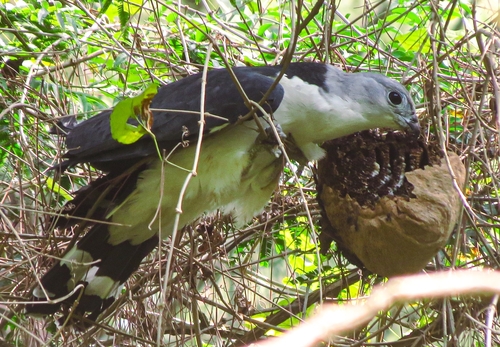
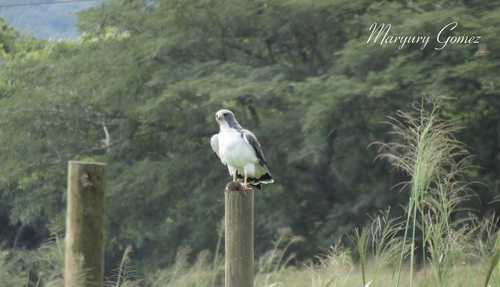
The plumbeous kite (Ictinia plumbea) is a bird of prey in the family Accipitridae that is resident in much of northern South America. It is migratory in the northern part of its range which extends north to Mexico. It feeds on insects which it catches either from a perch or while in flight.
The plumbeous kite was formally described in 1788 by the German naturalist Johann Friedrich Gmelin in his revised and expanded edition of Carl Linnaeus's Systema Naturae. He placed it with the eagles, hawks and relatives in the genus Falco and coined the binomial name Falco plumbeus. Gmelin based his description on the "spotted-tailed hawk" that had been described in 1781 by the English ornithologist John Latham from a specimen from Cayenne in a private collection in London. It is now placed with the Mississippi kite in the genus Ictinia that was introduced in 1816 by the French ornithologist Louis Pierre Vieillot. The genus name is from the Ancient Greek iktinos for a kite. The specific epithet plumbea is from Latin plumbeus meaning "leaded", "plumbeous" or "lead-coloured". The species is monotypic: no subspecies are recognised.
The plumbeous kite is 34–37.5 cm...