Western Wood-Pewee

Western Wood-Pewee

Contopus sordidulus

Silhouette: Andy Wilson · PhyloPic

LCLeast ConcernNTVUENCR
Daily sighting probability <5% · Rare
at Manuel Antonio National Park

In 3 days <5% in a week ~10%

19 Verified sightings at Manuel Antonio National Park From 2019 to 2026
10,404 In all 65 parks
October Best month
☀️ Diurnal When it's spotted

About the Western Wood-Pewee

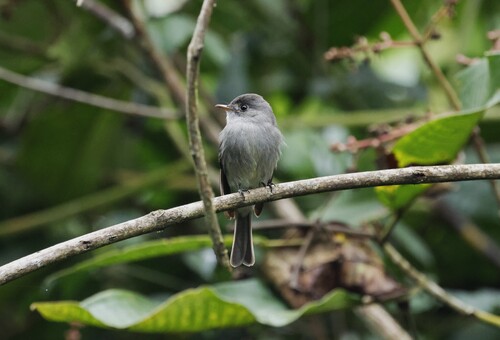
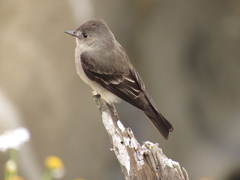
The western wood pewee (Contopus sordidulus) is a small tyrant flycatcher. Adults are gray-olive on the upperparts with light underparts, washed with olive on the breast. They have two wing bars and a dark bill with yellow at the base of the lower mandible. This bird is very similar in appearance to the eastern wood pewee; the two birds were formerly considered to be one species. The call of C. sordidulus is a loud buzzy peeer; the song consists of three rapid descending tsees ending with a descending peeer. The bird is about 5.5–6.3 in (14–16 cm) in length, 0.4–0.5 oz (11–14 g) in weight, and has a wingspan of 10.2 in (26 cm).

Their breeding habitat is open wooded areas in western North America. These birds migrate to South America at the end of summer. The female lays two or three eggs in an open cup nest on a horizontal tree branch or within a tree cavity; California black oak forests are examples of suitable nesting habitat for this species of bird. Both parents feed the young.

They often wait on a perch at a middle height in a tree and fly out to catch insects in flight (hawking), and will also hover to pluck insects from... Wikipedia →

Sounds

Call1:18

Ecuador · 2025

© Marc Anderson · XC1094057 · CC BY-NC-ND 4.0

Uncertain0:22

United States · 2024

© Denis Dujardin · XC1056076 · CC BY-NC-SA 4.0

Song0:14

Canada · 2024

© Brian Cox · XC939211 · CC BY-NC-SA 4.0

Global Distribution

Parks Where Found

# Park Country Daily sighting probability
1 Yosemite National Park 🇺🇸 United States
~40%
2 Guadalupe Mountains National Park 🇺🇸 United States
~30%
3 Sequoia and Kings Canyon National Parks 🇺🇸 United States
~20%
4 Grand Teton National Park 🇺🇸 United States
~20%
5 Wrangell-St. Elias National Park 🇺🇸 United States
~20%
6 Glacier National Park 🇺🇸 United States
~20%
7 Rocky Mountain National Park 🇺🇸 United States
~20%
8 Big Bend National Park 🇺🇸 United States
~10%
9 Death Valley National Park 🇺🇸 United States
~10%
10 Elk Island National Park 🇨🇦 Canada
~10%
11 Kluane National Park 🇨🇦 Canada
~10%
12 Podocarpus National Park 🇪🇨 Ecuador
~10%
13 Zion National Park 🇺🇸 United States
~10%
14 Grand Canyon National Park 🇺🇸 United States
~10%
15 Yellowstone National Park 🇺🇸 United States
~10%
16 El Triunfo 🇲🇽 Mexico
~10%
17 Amboró National Park 🇧🇴 Bolivia
~10%
18 Rincón de la Vieja National Park 🇨🇷 Costa Rica
~10%
19 Jasper National Park 🇨🇦 Canada
<5%
20 Redwood National Park 🇺🇸 United States
<5%
21 Braulio Carrillo National Park 🇨🇷 Costa Rica
<5%
22 Santa Rosa National Park 🇨🇷 Costa Rica
<5%
23 Monteverde Cloud Forest Reserve 🇨🇷 Costa Rica
<5%
24 La Amistad International Park (Panama) 🇵🇦 Panama
<5%
25 Cañón del Sumidero National Park 🇲🇽 Mexico
<5%
26 La Tigra National Park 🇭🇳 Honduras
<5%
27 Tapantí-Macizo de la Muerte National Park 🇨🇷 Costa Rica
<5%
28 Farallones de Cali National Natural Park 🇨🇴 Colombia
<5%
29 Tenorio Volcano National Park 🇨🇷 Costa Rica
<5%
30 Joshua Tree National Park 🇺🇸 United States
<5%
31 Banff National Park 🇨🇦 Canada
<5%
32 Arenal Volcano National Park 🇨🇷 Costa Rica
<5%
33 Corcovado National Park 🇨🇷 Costa Rica
<5%
34 Gandoca-Manzanillo Wildlife Refuge 🇨🇷 Costa Rica
<5%
35 Volcán Barú National Park 🇵🇦 Panama
<5%
36 Chirripó National Park 🇨🇷 Costa Rica
<5%
37 Cahuita National Park 🇨🇷 Costa Rica
<5%
38 Parque Natural Metropolitano 🇵🇦 Panama
<5%
39 Marino Ballena National Park 🇨🇷 Costa Rica
<5%
40 Piedras Blancas National Park 🇨🇷 Costa Rica
<5%
41 Biotopo Cerro Cahuí 🇬🇹 Guatemala
<5%
42 Los Quetzales National Park 🇨🇷 Costa Rica
<5%
43 Olympic National Park 🇺🇸 United States
<5%
44 Badlands National Park 🇺🇸 United States
<5%
45 Saguaro National Park 🇺🇸 United States
<5%
46 Bastimentos Island National Marine Park 🇵🇦 Panama
<5%
47 Tortuguero National Park 🇨🇷 Costa Rica
<5%
48 Poás Volcano National Park 🇨🇷 Costa Rica
<5%
49 Carara National Park 🇨🇷 Costa Rica
<5%
50 Darién National Park 🇵🇦 Panama
<5%
51 Great Bear Rainforest 🇨🇦 Canada
<5%
52 Machalilla National Park 🇪🇨 Ecuador
<5%
53 Cumbres de Monterrey National Park 🇲🇽 Mexico
<5%
54 Manuel Antonio National Park 🇨🇷 Costa Rica
<5%
55 Palo Verde National Park 🇨🇷 Costa Rica
<5%
56 Chingaza National Natural Park 🇨🇴 Colombia
<5%
57 Channel Islands National Park 🇺🇸 United States
<5%
58 Chagres National Park 🇵🇦 Panama
<5%
59 Tikal National Park 🇬🇹 Guatemala
<5%
60 Denali National Park 🇺🇸 United States
<5%
61 Sierra de la Macarena National Park 🇨🇴 Colombia
<5%
62 Soberanía National Park 🇵🇦 Panama
<5%
63 Masaya Volcano National Park 🇳🇮 Nicaragua
<5%
64 Los Nevados National Natural Park 🇨🇴 Colombia
<5%
65 Yasuní National Park 🇪🇨 Ecuador
<5%

Cities Where Found

# City Country Daily sighting probability
1 Toluca 🇲🇽 México
~10%
2 Calgary 🇨🇦 Canada
~10%
3 Mexico City 🇲🇽 México
~10%
4 Portland 🇺🇸 United States
~10%
5 Ciudad Juárez 🇲🇽 México
~10%
6 Puebla 🇲🇽 México
~10%
7 Guatemala City 🇬🇹 Guatemala
~10%
8 Denver 🇺🇸 United States
<5%
9 Vancouver 🇨🇦 Canada
<5%
10 Las Vegas 🇺🇸 United States
<5%

Before you go

What are the chances of seeing a Western Wood-Pewee in Manuel Antonio National Park?

Rare

Under 5% of wildlife watchers report a Western Wood-Pewee sighting in Manuel Antonio National Park on a given day, based on 19 verified sightings from GBIF citizen-science data from 2019 to 2026. It is the 218th most-seen of the 325 birds we can rate there. Over three days the chance rises to under 5%, and over a week to about 10%, if each day is a fresh chance.

When is the best time to see a Western Wood-Pewee in Manuel Antonio National Park?

Any time of year

In every month with enough records, under 5% of wildlife watchers report a Western Wood-Pewee in Manuel Antonio National Park on a given day, so our monthly data shows no clear season.

What time of day is best to see a Western Wood-Pewee?

Between 8 and 11 am

Across all the parks we cover, that three-hour window holds the most Western Wood-Pewee sightings with a recorded time, and about 9 in 10 of them come between 6 am and 6 pm: it is a daytime animal.

Where does the Western Wood-Pewee sighting chance come from?

GBIF citizen-science records

It is estimated from how often the Western Wood-Pewee is recorded against all the birds logged in Manuel Antonio National Park (19 verified sightings from 2019 to 2026), calibrated against known sighting rates. Figures are rounded to the nearest 10% because citizen-science data supports honest approximations, not decimals, and months with records from fewer than five people show "—". How it works.

← Back to Manuel Antonio National Park