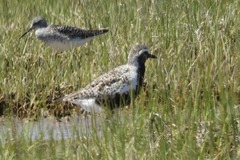
Black-bellied Plover

Black-bellied Plover

Pluvialis squatarola

Silhouette: Emily Willoughby · PhyloPic

LCNTVUVulnerableENCR
Daily sighting probability ~60% · Likely
at West Coast National Park

In 3 days ~90% in a week >90%

929 Verified sightings at West Coast National Park From 2019 to 2026
16,436 In all 64 parks
April Best month
☀️ Diurnal When it's spotted

About the Black-bellied Plover

The grey plover or black-bellied plover (Pluvialis squatarola) is a large plover breeding in Arctic regions. It is a long-distance migrant, with a nearly worldwide coastal distribution when not breeding. The grey plover was formally described by the Swedish naturalist Carl Linnaeus in 1758 in the tenth edition of his Systema Naturae under the binomial name Tringa squatarola. It is now placed with three other plovers in the genus Pluvialis that was introduced by the French ornithologist Mathurin Jacques Brisson in 1760. The genus name is Latin and means relating to rain, from pluvia, "rain". It was believed that they flocked when rain was imminent. The species name squatarola is a Latinised version of Sgatarola, a Venetian name for some kind of plover.

The English common name used for this species differs in different parts of the world. It is generally known as "grey plover" in the Old World and "black-bellied plover" in the New World. Three subspecies are recognised: Wikipedia →

Sounds

Nocturnal flight call0:46

France · 2026

© MERCIER Christophe · XC1185855 · CC BY-NC-SA 4.0

Call0:21

China · 2019

© Bo Shunqi 薄顺奇 · XC840935 · CC BY-NC-SA 4.0

Flight call0:08

Sweden · 2021

© Teet Sirotkin · XC678452 · CC BY-NC-SA 4.0

Global Distribution

Parks Where Found

# Park Country Daily sighting probability
1 Padre Island National Seashore 🇺🇸 United States
~60%
2 West Coast National Park 🇿🇦 South Africa
~60%
3 Ría Lagartos Biosphere Reserve 🇲🇽 Mexico
~50%
4 Camargue 🇫🇷 France
~30%
5 Arrecifes de Cozumel National Park 🇲🇽 Mexico
~30%
6 Bahía de Loreto National Park 🇲🇽 Mexico
~20%
7 Wadden Sea National Park 🇩🇪 Germany
~20%
8 Rottnest Island 🇦🇺 Australia
~20%
9 Ciénaga de Zapata 🇨🇺 Cuba
~20%
10 El Vizcaíno Biosphere Reserve 🇲🇽 Mexico
~20%
11 Celestún Biosphere Reserve 🇲🇽 Mexico
~20%
12 Channel Islands National Park 🇺🇸 United States
~10%
13 Bali Barat National Park 🇮🇩 Indonesia
~10%
14 Point Pelee National Park 🇨🇦 Canada
~10%
15 Carara National Park 🇨🇷 Costa Rica
~10%
16 Kiskunság National Park 🇭🇺 Hungary
~10%
17 Merritt Island National Wildlife Refuge 🇺🇸 United States
~10%
18 iSimangaliso Wetland Park 🇿🇦 South Africa
~10%
19 Pacific Rim National Park Reserve 🇨🇦 Canada
~10%
20 Hortobágy National Park 🇭🇺 Hungary
~10%
21 Jaragua National Park 🇩🇴 Dominican Republic
~10%
22 Bastimentos Island National Marine Park 🇵🇦 Panama
~10%
23 Cabo Blanco Absolute Nature Reserve 🇨🇷 Costa Rica
~10%
24 Everglades National Park 🇺🇸 United States
~10%
25 Doñana National Park 🇪🇸 Spain
~10%
26 Gandoca-Manzanillo Wildlife Refuge 🇨🇷 Costa Rica
~10%
27 Galápagos Islands 🇪🇨 Ecuador
~10%
28 Ostional Wildlife Refuge 🇨🇷 Costa Rica
~10%
29 Coiba National Park 🇵🇦 Panama
~10%
30 Yala National Park 🇱🇰 Sri Lanka
<5%
31 Caroni Swamp 🇹🇹 Trinidad and Tobago
<5%
32 Addo Elephant National Park 🇿🇦 South Africa
<5%
33 Isla del Coco National Park 🇨🇷 Costa Rica
<5%
34 Los Haitises National Park 🇩🇴 Dominican Republic
<5%
35 Tortuguero National Park 🇨🇷 Costa Rica
<5%
36 La Amistad International Park (Panama) 🇵🇦 Panama
<5%
37 Marino Ballena National Park 🇨🇷 Costa Rica
<5%
38 Garden Route National Park 🇿🇦 South Africa
<5%
39 Great Bear Rainforest 🇨🇦 Canada
<5%
40 Cape Range 🇦🇺 Australia
<5%
41 Cahuita National Park 🇨🇷 Costa Rica
<5%
42 Sian Ka'an Biosphere Reserve 🇲🇽 Mexico
<5%
43 Ningaloo Marine Park 🇦🇺 Australia
<5%
44 Tayrona National Natural Park 🇨🇴 Colombia
<5%
45 Fertő-Hanság National Park 🇭🇺 Hungary
<5%
46 Las Baulas Marine National Park 🇨🇷 Costa Rica
<5%
47 Santa Rosa National Park 🇨🇷 Costa Rica
<5%
48 De Hoop Nature Reserve 🇿🇦 South Africa
<5%
49 Białowieża National Park 🇵🇱 Poland
<5%
50 Palo Verde National Park 🇨🇷 Costa Rica
<5%
51 Snowdonia National Park 🇬🇧 United Kingdom
<5%
52 Gros Morne National Park 🇨🇦 Canada
<5%
53 Moremi Game Reserve 🇧🇼 Botswana
<5%
54 Acadia National Park 🇺🇸 United States
<5%
55 Tangkoko Nature Reserve 🇮🇩 Indonesia
<5%
56 Olympic National Park 🇺🇸 United States
<5%
57 Piedras Blancas National Park 🇨🇷 Costa Rica
<5%
58 Sierra de Guadarrama National Park 🇪🇸 Spain
<5%
59 Big Cypress National Preserve 🇺🇸 United States
<5%
60 Redwood National Park 🇺🇸 United States
<5%
61 Ngorongoro Conservation Area 🇹🇿 Tanzania
<5%
62 Corcovado National Park 🇨🇷 Costa Rica
<5%
63 Parque Natural Metropolitano 🇵🇦 Panama
<5%
64 Table Mountain National Park 🇿🇦 South Africa
<5%

Cities Where Found

# City Country Daily sighting probability
1 Zanzibar City 🇹🇿 Tanzania
~40%
2 Kuwait City 🇰🇼 Kuwait
~30%
3 Maputo 🇲🇿 Mozambique
~20%
4 Manama 🇧🇭 Bahrain
~20%
5 Havana 🇨🇺 Cuba
~20%
6 Dar es-Salaam 🇹🇿 Tanzania
~20%
7 Panama City 🇵🇦 Panama
~20%
8 Casablanca 🇲🇦 Morocco
~20%
9 Rabat 🇲🇦 Morocco
~10%
10 Mombasa 🇰🇪 Kenya
~10%

Zoos & Centres Where Found

# Zoo / Centre Country
1 Monterey Bay Aquarium 🇺🇸 United States In captivity
2 Seattle Aquarium 🇺🇸 United States In captivity
3 Montreal Biodome 🇨🇦 Canada In captivity
4 Seattle Marine Aquarium 🇺🇸 United States In captivity

Before you go

What are the chances of seeing a Black-bellied Plover in West Coast National Park?

Likely

About 60% of wildlife watchers report a Black-bellied Plover sighting in West Coast National Park on a given day, based on 929 verified sightings from GBIF citizen-science data from 2019 to 2026. It is the 24th most-seen of the 192 birds we can rate there. Over three days the chance rises to about 90%, and over a week to over 90%, if each day is a fresh chance.

When is the best time to see a Black-bellied Plover in West Coast National Park?

March and April

In those months about 80% of wildlife watchers report a Black-bellied Plover in West Coast National Park on a given day, against about 30% in August, the lowest month. Those are among West Coast National Park's driest months, with about 15 mm of rain a month against 70 mm in June.

What time of day is best to see a Black-bellied Plover?

Between 10 am and 1 pm

Across all the parks we cover, that three-hour window holds the most Black-bellied Plover sightings with a recorded time, and nearly all of them come between 6 am and 6 pm: it is a daytime animal.

Is West Coast National Park the best place to see a Black-bellied Plover?

Among the best

Of the 64 parks where we can rate Black-bellied Plover sightings, West Coast National Park ranks 2nd at about 60%, level with the leaders once rounded. The best odds are in Padre Island National Seashore (United States, about 60%). All parks ranked.

Where does the Black-bellied Plover sighting chance come from?

GBIF citizen-science records

It is estimated from how often the Black-bellied Plover is recorded against all the birds logged in West Coast National Park (929 verified sightings from 2019 to 2026), calibrated against known sighting rates. Figures are rounded to the nearest 10% because citizen-science data supports honest approximations, not decimals, and months with records from fewer than five people show "—". How it works.

← Back to West Coast National Park