Clay-colored Thrush

Clay-colored Thrush

Turdus grayi

Silhouette: Sharon Wegner-Larsen · PhyloPic

LCLeast ConcernNTVUENCR
Daily sighting probability ~40% · Likely
at Cahuita National Park

In 3 days ~70% in a week >90%

436 Verified sightings at Cahuita National Park From 2019 to 2026
91,378 In all 53 parks
March Best month
☀️ Diurnal When it's spotted

About the Clay-colored Thrush

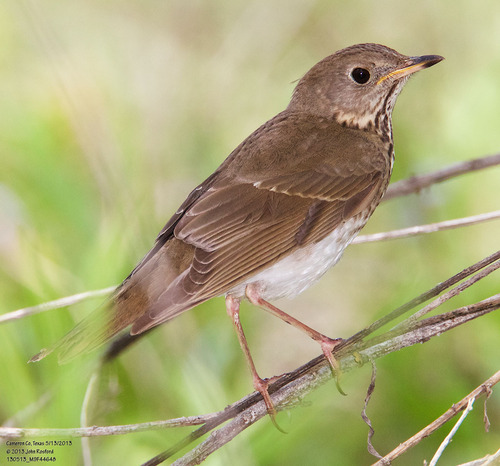
The clay-colored thrush (Turdus grayi) is a common Middle American bird of the thrush family (Turdidae). It is the national bird of Costa Rica, where it is well known as the yigüirro (Spanish: [ʝi'ɣwiro]). Other common names include clay-colored robin.

It ranges from South Texas (where it is rapidly expanding its range) to northern Colombia. West and north of the Isthmus of Tehuantepec, it is limited to the Atlantic slope, except for a population around Oaxaca City, Mexico that probably originates from escaped cage birds. In much of its range it is familiar in yards and gardens, similar to some other thrushes such as the American robin, the Eurasian blackbird, and the song thrush.

In general appearance and habits it resembles other Turdus thrushes such as the American robin. It is about the same length or slightly smaller: 23–27 cm (9.1–10.6 in), and weighs 74–76 g (2.6–2.7 oz) on average. The plumage is brownish, somewhat lighter below than above, lightest on the flanks. Birds from humid regions are darker than those from dry regions. The throat is faintly streaked. Immature birds have faint mottling on the back and underparts. The... Wikipedia →

Sounds

Call0:44

Guatemala · 2026

© Leander Khil · XC1139800 · CC BY-NC-SA 4.0

Song1:08

Honduras · 2025

Alfonso Auerbach · XC994278 · CC0

Imitation1:23

Mexico · 2021

© Manuel Grosselet · XC653347 · CC BY-NC-SA 4.0

Global Distribution

Parks Where Found

# Park Country Daily sighting probability
1 Masaya Volcano National Park 🇳🇮 Nicaragua
~90%
2 Poás Volcano National Park 🇨🇷 Costa Rica
~80%
3 Cerro Azul Meámbar National Park 🇭🇳 Honduras
~80%
4 El Triunfo 🇲🇽 Mexico
~80%
5 Cusuco National Park 🇭🇳 Honduras
~80%
6 Arenal Volcano National Park 🇨🇷 Costa Rica
~70%
7 Tenorio Volcano National Park 🇨🇷 Costa Rica
~70%
8 Chagres National Park 🇵🇦 Panama
~70%
9 Lago de Yojoa 🇭🇳 Honduras
~70%
10 Los Quetzales National Park 🇨🇷 Costa Rica
~70%
11 Pico Bonito National Park 🇭🇳 Honduras
~60%
12 Volcán Barú National Park 🇵🇦 Panama
~60%
13 Parque Natural Metropolitano 🇵🇦 Panama
~60%
14 Braulio Carrillo National Park 🇨🇷 Costa Rica
~60%
15 Cañón del Sumidero National Park 🇲🇽 Mexico
~60%
16 Cumbres de Monterrey National Park 🇲🇽 Mexico
~60%
17 Chirripó National Park 🇨🇷 Costa Rica
~60%
18 Tapantí-Macizo de la Muerte National Park 🇨🇷 Costa Rica
~60%
19 La Amistad International Park (Panama) 🇵🇦 Panama
~50%
20 Carara National Park 🇨🇷 Costa Rica
~50%
21 Cockscomb Basin Wildlife Sanctuary 🇧🇿 Belize
~50%
22 Celaque National Park 🇭🇳 Honduras
~50%
23 Montes Azules Biosphere Reserve 🇲🇽 Mexico
~50%
24 Monteverde Cloud Forest Reserve 🇨🇷 Costa Rica
~50%
25 Sian Ka'an Biosphere Reserve 🇲🇽 Mexico
~50%
26 Soberanía National Park 🇵🇦 Panama
~50%
27 Piedras Blancas National Park 🇨🇷 Costa Rica
~50%
28 Gandoca-Manzanillo Wildlife Refuge 🇨🇷 Costa Rica
~40%
29 Calakmul Biosphere Reserve 🇲🇽 Mexico
~40%
30 Rincón de la Vieja National Park 🇨🇷 Costa Rica
~40%
31 La Tigra National Park 🇭🇳 Honduras
~40%
32 Manuel Antonio National Park 🇨🇷 Costa Rica
~40%
33 Tortuguero National Park 🇨🇷 Costa Rica
~40%
34 Marino Ballena National Park 🇨🇷 Costa Rica
~40%
35 Cahuita National Park 🇨🇷 Costa Rica
~40%
36 San Lorenzo Protected Forest 🇵🇦 Panama
~30%
37 Bastimentos Island National Marine Park 🇵🇦 Panama
~30%
38 Tikal National Park 🇬🇹 Guatemala
~30%
39 Santa Rosa National Park 🇨🇷 Costa Rica
~30%
40 Ostional Wildlife Refuge 🇨🇷 Costa Rica
~30%
41 Cabo Blanco Absolute Nature Reserve 🇨🇷 Costa Rica
~30%
42 Tayrona National Natural Park 🇨🇴 Colombia
~30%
43 Irazú Volcano National Park 🇨🇷 Costa Rica
~20%
44 Corcovado National Park 🇨🇷 Costa Rica
~20%
45 Biotopo Cerro Cahuí 🇬🇹 Guatemala
~20%
46 Las Baulas Marine National Park 🇨🇷 Costa Rica
~20%
47 Palo Verde National Park 🇨🇷 Costa Rica
~20%
48 Celestún Biosphere Reserve 🇲🇽 Mexico
~10%
49 Arrecifes de Cozumel National Park 🇲🇽 Mexico
~10%
50 Coiba National Park 🇵🇦 Panama
~10%
51 Darién National Park 🇵🇦 Panama
<5%
52 Ría Lagartos Biosphere Reserve 🇲🇽 Mexico
<5%
53 Farallones de Cali National Natural Park 🇨🇴 Colombia
<5%

Cities Where Found

# City Country Daily sighting probability
1 Tegucigalpa 🇭🇳 Honduras
~90%
2 San José 🇨🇷 Costa Rica
~90%
3 Managua 🇳🇮 Nicaragua
~80%
4 Guatemala City 🇬🇹 Guatemala
~80%
5 San Pedro Sula 🇭🇳 Honduras
~80%
6 San Salvador 🇸🇻 El Salvador
~70%
7 Panama City 🇵🇦 Panama
~60%
8 Monterrey 🇲🇽 México
~50%
9 Barranquilla 🇨🇴 Colombia
~20%
10 San Luis Potosí 🇲🇽 México
~10%

Zoos & Centres Where Found

# Zoo / Centre Country
1 Xcaret 🇲🇽 Mexico In captivity

Before you go

What are the chances of seeing a Clay-colored Thrush in Cahuita National Park?

Likely

About 40% of wildlife watchers report a Clay-colored Thrush sighting in Cahuita National Park on a given day, based on 436 verified sightings from GBIF citizen-science data from 2019 to 2026. It is the 20th most-seen of the 303 birds we can rate there. Over three days the chance rises to about 70%, and over a week to over 90%, if each day is a fresh chance.

When is the best time to see a Clay-colored Thrush in Cahuita National Park?

March

In that month about 60% of wildlife watchers report a Clay-colored Thrush in Cahuita National Park on a given day, against about 20% in July and September, the lowest months. That is one of Cahuita National Park's driest months, with about 170 mm of rain against 560 mm in July.

What time of day is best to see a Clay-colored Thrush?

Between 8 and 11 am

Across all the parks we cover, that three-hour window holds the most Clay-colored Thrush sightings with a recorded time, and about 9 in 10 of them come between 6 am and 6 pm: it is a daytime animal.

Where does the Clay-colored Thrush sighting chance come from?

GBIF citizen-science records

It is estimated from how often the Clay-colored Thrush is recorded against all the birds logged in Cahuita National Park (436 verified sightings from 2019 to 2026), calibrated against known sighting rates. Figures are rounded to the nearest 10% because citizen-science data supports honest approximations, not decimals, and months with records from fewer than five people show "—". How it works.

← Back to Cahuita National Park