Zone-tailed Hawk

Zone-tailed Hawk

Buteo albonotatus

Silhouette: Lauren Anderson · PhyloPic

LCLeast ConcernNTVUENCR
Daily sighting probability <5% · Rare
at Manu National Park

In 3 days <5% in a week ~10%

43 Verified sightings at Manu National Park From 2019 to 2026
3,593 In all 53 parks
March Best month
☀️ Diurnal When it's spotted

About the Zone-tailed Hawk

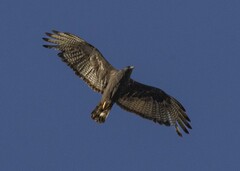
The zone-tailed hawk (Buteo albonotatus) is a medium-sized hawk of warm, dry parts of the Americas. It is somewhat similar in plumage and flight style to a common scavenger, the turkey vulture, and may benefit from being able to blend into groups of vultures. It feeds on small terrestrial tetrapods of all kinds.

In 1844, the English zoologist George Robert Gray, in his List of the Specimens of Birds in the Collection of the British Museum, mentioned the zone-tailed hawk under the common name "white spotted buzzard" and coined the binomial name Buteo albonotatus. As Gray omitted a species description, his binomial name is considered nomen nudum, a naked name, and is not recognised. Instead, the German naturalist Johann Jakob Kaup is recognised as the authority as in 1847, he provided a brief description and used Gray's name Buteo albonotatus. The type locality is Mexico. The specific epithet albonotatus combines the Latin albus meaning "white" with notatus meaning "marked". The species is monotypic: no subspecies are recognised.

The zone-tailed hawk is a fairly large but slender Buteo hawk. Grown birds are 46 to 56 cm (18 to 22 in) in length with a... Wikipedia →

Sounds

Call1:28

United States · 2024

© Matt Wistrand · XC915547 · CC BY-NC-SA 4.0

Flight call0:11

Ecuador · 2002

© John V. Moore · XC257373 · CC BY-NC-SA 4.0

Call0:44

United States · 2023

© Gregory Askew · XC793837 · CC BY-NC-SA 4.0

Global Distribution

Parks Where Found

# Park Country Daily sighting probability
1 Grand Canyon National Park 🇺🇸 United States
~20%
2 Big Bend National Park 🇺🇸 United States
~10%
3 Cerro Azul Meámbar National Park 🇭🇳 Honduras
~10%
4 Carara National Park 🇨🇷 Costa Rica
~10%
5 Palo Verde National Park 🇨🇷 Costa Rica
~10%
6 Cabo Pulmo National Park 🇲🇽 Mexico
~10%
7 Ría Lagartos Biosphere Reserve 🇲🇽 Mexico
~10%
8 Cusuco National Park 🇭🇳 Honduras
~10%
9 Bahía de Loreto National Park 🇲🇽 Mexico
<5%
10 Lago de Yojoa 🇭🇳 Honduras
<5%
11 El Vizcaíno Biosphere Reserve 🇲🇽 Mexico
<5%
12 Soberanía National Park 🇵🇦 Panama
<5%
13 Tayrona National Natural Park 🇨🇴 Colombia
<5%
14 Cumbres de Monterrey National Park 🇲🇽 Mexico
<5%
15 Machalilla National Park 🇪🇨 Ecuador
<5%
16 Celestún Biosphere Reserve 🇲🇽 Mexico
<5%
17 Caroni Swamp 🇹🇹 Trinidad and Tobago
<5%
18 Celaque National Park 🇭🇳 Honduras
<5%
19 Manuel Antonio National Park 🇨🇷 Costa Rica
<5%
20 Cañón del Sumidero National Park 🇲🇽 Mexico
<5%
21 San Lorenzo Protected Forest 🇵🇦 Panama
<5%
22 Chagres National Park 🇵🇦 Panama
<5%
23 Parque Natural Metropolitano 🇵🇦 Panama
<5%
24 Cabo Blanco Absolute Nature Reserve 🇨🇷 Costa Rica
<5%
25 Chirripó National Park 🇨🇷 Costa Rica
<5%
26 Cahuita National Park 🇨🇷 Costa Rica
<5%
27 Sian Ka'an Biosphere Reserve 🇲🇽 Mexico
<5%
28 Bastimentos Island National Marine Park 🇵🇦 Panama
<5%
29 Marino Ballena National Park 🇨🇷 Costa Rica
<5%
30 Henri Pittier National Park 🇻🇪 Venezuela
<5%
31 Manu National Park 🇵🇪 Peru
<5%
32 Guadalupe Mountains National Park 🇺🇸 United States
<5%
33 Death Valley National Park 🇺🇸 United States
<5%
34 Amacayacu National Natural Park 🇨🇴 Colombia
<5%
35 Pico Bonito National Park 🇭🇳 Honduras
<5%
36 Chapada Diamantina National Park 🇧🇷 Brazil
<5%
37 La Amistad International Park (Panama) 🇵🇦 Panama
<5%
38 Saguaro National Park 🇺🇸 United States
<5%
39 Piedras Blancas National Park 🇨🇷 Costa Rica
<5%
40 Tambopata National Reserve 🇵🇪 Peru
<5%
41 Tenorio Volcano National Park 🇨🇷 Costa Rica
<5%
42 Las Baulas Marine National Park 🇨🇷 Costa Rica
<5%
43 Arenal Volcano National Park 🇨🇷 Costa Rica
<5%
44 Masaya Volcano National Park 🇳🇮 Nicaragua
<5%
45 Corcovado National Park 🇨🇷 Costa Rica
<5%
46 Volcán Barú National Park 🇵🇦 Panama
<5%
47 Tikal National Park 🇬🇹 Guatemala
<5%
48 Braulio Carrillo National Park 🇨🇷 Costa Rica
<5%
49 Farallones de Cali National Natural Park 🇨🇴 Colombia
<5%
50 Tijuca National Park 🇧🇷 Brazil
<5%
51 Monteverde Cloud Forest Reserve 🇨🇷 Costa Rica
<5%
52 Poás Volcano National Park 🇨🇷 Costa Rica
<5%
53 Tapantí-Macizo de la Muerte National Park 🇨🇷 Costa Rica
<5%

Cities Where Found

# City Country Daily sighting probability
1 Tegucigalpa 🇭🇳 Honduras
<5%
2 Caracas 🇻🇪 Venezuela
<5%
3 Panama City 🇵🇦 Panama
<5%
4 Salvador 🇧🇷 Brazil
<5%
5 Guadalajara 🇲🇽 México
<5%
6 Vitória 🇧🇷 Brazil
<5%
7 Monterrey 🇲🇽 México
<5%
8 San Pedro Sula 🇭🇳 Honduras
<5%
9 Mesa 🇺🇸 United States
<5%
10 Maceió 🇧🇷 Brazil
<5%

Zoos & Centres Where Found

# Zoo / Centre Country
1 Ecological Center of Sonora 🇲🇽 Mexico In captivity
2 Parque Municipal Summit 🇵🇦 Panama In captivity

Before you go

What are the chances of seeing a Zone-tailed Hawk in Manu National Park?

Rare

Under 5% of wildlife watchers report a Zone-tailed Hawk sighting in Manu National Park on a given day, based on 43 verified sightings from GBIF citizen-science data from 2019 to 2026. It is the 466th most-seen of the 641 birds we can rate there. Over three days the chance rises to under 5%, and over a week to about 10%, if each day is a fresh chance.

When is the best time to see a Zone-tailed Hawk in Manu National Park?

Any time of year

In every month with enough records, under 5% of wildlife watchers report a Zone-tailed Hawk in Manu National Park on a given day, so our monthly data shows no clear season.

What time of day is best to see a Zone-tailed Hawk?

Between 8 and 11 am

Across all the parks we cover, that three-hour window holds the most Zone-tailed Hawk sightings with a recorded time, and about 9 in 10 of them come between 6 am and 6 pm: it is a daytime animal.

Where does the Zone-tailed Hawk sighting chance come from?

GBIF citizen-science records

It is estimated from how often the Zone-tailed Hawk is recorded against all the birds logged in Manu National Park (43 verified sightings from 2019 to 2026), calibrated against known sighting rates. Figures are rounded to the nearest 10% because citizen-science data supports honest approximations, not decimals, and months with records from fewer than five people show "—". How it works.

← Back to Manu National Park
