





Completed

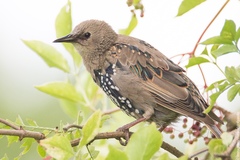



European Starling
Sturnus vulgaris
Silhouette: Gareth Monger · PhyloPic
- KingdomAnimalia (Animals)
- PhylumChordata (Chordates)
- ClassAves (Birds)
- OrderPasseriformes (Perching Birds)
- FamilySturnidae (Starlings)
- GenusSturnus (European and Spotless Starlings)
- SpeciesSturnus vulgaris (European Starling)
In 3 days ~10% in a week ~20%
118 Verified sightings at Yosemite National Park From 2019 to 2026
46,410 In all 81 parks
March Best month
☀️ Diurnal When it's spotted
About the European Starling
The common starling (Sturnus vulgaris), also known simply as the starling in Great Britain and Ireland, and as the European starling in North America, is a medium-sized passerine bird in the starling family, Sturnidae. It is about 20 cm (8 in) long and has glossy black plumage with a metallic sheen, which is speckled with white at some times of the year. The legs are pink and the bill is black in winter and yellow in summer; young birds have browner plumage than the adults. Its gift for mimicry has been noted in literature including the Mabinogion and the works of Pliny the Elder and William Shakespeare.
The common starling has about 12 subspecies breeding in open habitats across its native range in temperate Europe and across the Palearctic to western Mongolia, and it has been introduced as an invasive species to Australia, New Zealand, Canada, the United States, Mexico, Argentina, South Africa and Fiji. This bird is resident in western and southern Europe and southwestern Asia, while northeastern populations migrate south and west in the winter within the breeding range and also further south to Iberia and North Africa. The common starling builds an untidy nest in a natural or artificial cavity in which four or five glossy, pale blue eggs are laid. These take two weeks to hatch and the young remain in the nest for another three weeks. There are normally one or two breeding attempts each year. This species is omnivorous, taking a wide range of invertebrates, as well as seeds and fruit. It is hunted by various mammals and birds of prey, and is host to a range of external and internal parasites.
Large flocks typical of this species can be beneficial to agriculture by controlling invertebrate pests; however, starlings can also be pests themselves when they feed on fruit and sprouting crops. Common starlings may also be a nuisance through the noise and mess caused by their large urban roosts. Introduced populations in particular have been subjected to a range of controls, including culling, but these have had limited success, except in preventing the colonisation of Western Australia.
The species has declined in numbers in parts of northern and western Europe since the 1980s due to fewer grassland invertebrates being available as food for growing chicks. Despite this, its huge global population is not thought to be declining significantly, so the common starling is classified as being of least concern by the International Union for Conservation of Nature. Wikipedia →
Recent sightings of European Starling in Yosemite National Park
LIVEiNaturalistGlobal Distribution
Parks Where Found
Cities Where Found
| # | City | Country | Daily sighting probability |
|---|---|---|---|
| 1 | Phoenix | 🇺🇸 United States | |
| 2 | Sincan | 🇹🇷 Turkey | |
| 3 | Baltimore | 🇺🇸 United States | |
| 4 | New York City | 🇺🇸 United States | |
| 5 | Cape Town | 🇿🇦 South Africa | |
| 6 | Milan | 🇮🇹 Italy | |
| 7 | Liverpool | 🇬🇧 United Kingdom | |
| 8 | Auckland | 🇳🇿 New Zealand | |
| 9 | Detroit | 🇺🇸 United States | |
| 10 | Tehran | 🇮🇷 Iran |
Zoos & Centres Where Found
| # | Zoo / Centre | Country | |
|---|---|---|---|
| 1 | Prague Zoo | 🇨🇿 Czechia | |
| 2 | Bronx Zoo | 🇺🇸 United States | |
| 3 | Warsaw Zoo | 🇵🇱 Poland | |
| 4 | Wrocław Zoological Garden | 🇵🇱 Poland | |
| 5 | Fort Worth Zoo | 🇺🇸 United States | |
| 6 | Budapest Zoo & Botanical Garden | 🇭🇺 Hungary | |
| 7 | Tierpark Hexentanzplatz | 🇩🇪 Germany | |
| 8 | Santillana Zoo | 🇪🇸 Spain | |
| 9 | World of Birds Wildlife Sanctuary and Monkey Park | 🇿🇦 South Africa | |
| 10 | Alpenzoo Innsbruck | 🇦🇹 Austria | |
| 11 | California Raptor Center | 🇺🇸 United States | |
| 12 | Sawgrass Nature Center | 🇺🇸 United States | |
| 13 | Africarium | 🇵🇱 Poland | |
| 14 | herpetarium warszawskiego ZOO | 🇵🇱 Poland | |
| 15 | Rákosův pavilon | 🇨🇿 Czechia | |
| 16 | Velemlokárium | 🇨🇿 Czechia | |
| 17 | akwarium warszawskiego ZOO | 🇵🇱 Poland | |
| 18 | Ogród Zoologiczny w Katowicach | 🇵🇱 Poland | |
| 19 | terrarium ogrodu zoologicznego we Wrocławiu | 🇵🇱 Poland |
Closest Relatives at Yosemite National Park








Before you go
What are the chances of seeing a European Starling in Yosemite National Park?
Rare
Under 5% of wildlife watchers report a European Starling sighting in Yosemite National Park on a given day, based on 118 verified sightings from GBIF citizen-science data from 2019 to 2026. It is the 99th most-seen of the 169 birds we can rate there. Over three days the chance rises to about 10%, and over a week to about 20%, if each day is a fresh chance.
When is the best time to see a European Starling in Yosemite National Park?
January and March–June
In those months about 10% of wildlife watchers report a European Starling in Yosemite National Park on a given day, against under 5% in February and July–December, the lowest months.
What time of day is best to see a European Starling?
Between noon and 3 pm
Across all the parks we cover, that three-hour window holds the most European Starling sightings with a recorded time, and about 8 in 10 of them come between 6 am and 6 pm: it is a daytime animal.
Is Yosemite National Park the best place to see a European Starling?
66th of 81
Of the 81 parks where we can rate European Starling sightings, Yosemite National Park ranks 66th at under 5%. The best odds are in Hortobágy National Park (Hungary, about 80%), Kiskunság National Park (Hungary, about 70%) and Egmont National Park (New Zealand, about 70%). All parks ranked.
Which relatives of the European Starling live in Yosemite National Park?
Same order: Passeriformes
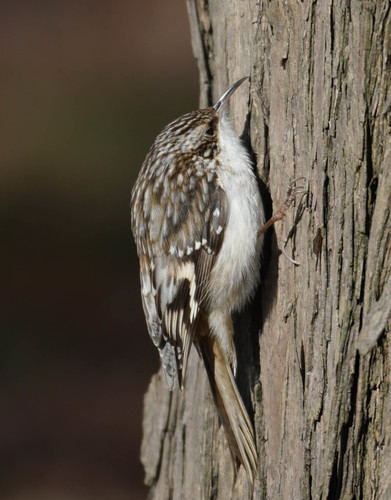
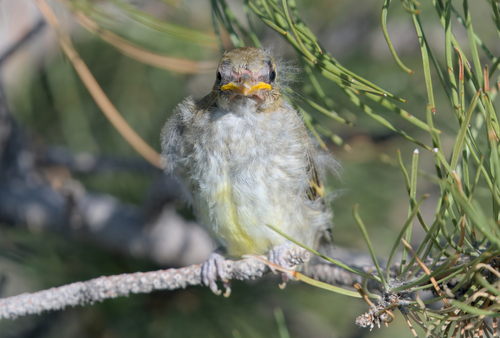
The closest relatives of the European Starling that you can see in Yosemite National Park (order Passeriformes, Perching Birds) are Dark-eyed Junco (about 80%), Steller's Jay (about 80%) and Common Raven (about 80%), with each one's daily chance of a sighting.
Where does the European Starling sighting chance come from?
GBIF citizen-science records
It is estimated from how often the European Starling is recorded against all the birds logged in Yosemite National Park (118 verified sightings from 2019 to 2026), calibrated against known sighting rates. Figures are rounded to the nearest 10% because citizen-science data supports honest approximations, not decimals, and months with records from fewer than five people show "—". How it works.
