
Solitary Sandpiper

Solitary Sandpiper

Tringa solitaria

Silhouette: Andy Wilson · PhyloPic

LCLeast ConcernNTVUENCR
Daily sighting probability <5% · Rare
at Minneapolis [Saint Paul]

In 3 days <5% in a week ~10%

277 Verified sightings at Minneapolis [Saint Paul]
3,967 In all 71 parks From 2019 to 2026
July Best month
☀️ Diurnal When it's spotted

About the Solitary Sandpiper

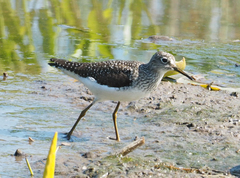
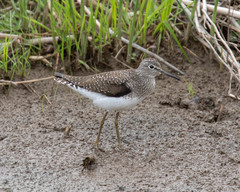
The solitary sandpiper (Tringa solitaria) is a small shorebird. The genus name Tringa is the Neo-Latin name given to the green sandpiper by Aldrovandus in 1599 based on Ancient Greek trungas, a thrush-sized, white-rumped, tail-bobbing wading bird mentioned by Aristotle. The specific solitaria is Latin for "solitary" from solus, "alone".

This species measures 18–23 cm (7.1–9.1 in) long, with a wingspan up to 50 cm (20 in) and a body mass of 31–65 g (1.1–2.3 oz). It is a dumpy wader with a dark green back, greyish head and breast and otherwise white underparts. It is obvious in flight, with wings dark above and below, and a dark rump and tail centre. The latter feature distinguishes it from the slightly larger and broader-winged, but otherwise very similar, green sandpiper (T. ochropus) of Europe and Asia, to which it is closely related. The latter species has a brilliant white rump. In flight, the solitary sandpiper has a characteristic three-note whistle. They both have brown wings with little light dots, and a delicate but contrasting neck and chest pattern. In addition, both species nest in trees, unlike most other scolopacids.

It breeds... Wikipedia →

Sounds

Call0:19

Brazil · 2025

© JAYRSON ARAUJO DE OLIVEIRA · XC961361 · CC BY-NC-SA 4.0

Flight call0:15

United States · 2022

© Richard E. Webster · XC774176 · CC BY-NC-SA 4.0

Alarm call0:28

Canada · 1985

© Peter Ward and Ken Hall · XC606780 · CC BY-NC-SA 4.0

Global Distribution

Parks Where Found

# Park Country Daily sighting probability
1 Wrangell-St. Elias National Park 🇺🇸 United States
~20%
2 Caroni Swamp 🇹🇹 Trinidad and Tobago
~20%
3 Elk Island National Park 🇨🇦 Canada
~10%
4 Palo Verde National Park 🇨🇷 Costa Rica
~10%
5 Isla del Coco National Park 🇨🇷 Costa Rica
~10%
6 Los Haitises National Park 🇩🇴 Dominican Republic
~10%
7 Kluane National Park 🇨🇦 Canada
~10%
8 Anavilhanas National Park 🇧🇷 Brazil
~10%
9 Wood Buffalo National Park 🇨🇦 Canada
~10%
10 El Impenetrable National Park 🇦🇷 Argentina
~10%
11 Jasper National Park 🇨🇦 Canada
~10%
12 Manu National Park 🇵🇪 Peru
~10%
13 Cuyabeno Wildlife Reserve 🇪🇨 Ecuador
~10%
14 Iberá National Park 🇦🇷 Argentina
~10%
15 Parque Estadual Encontro das Águas 🇧🇷 Brazil
~10%
16 Calakmul Biosphere Reserve 🇲🇽 Mexico
~10%
17 Denali National Park 🇺🇸 United States
<5%
18 Gandoca-Manzanillo Wildlife Refuge 🇨🇷 Costa Rica
<5%
19 Celestún Biosphere Reserve 🇲🇽 Mexico
<5%
20 Coiba National Park 🇵🇦 Panama
<5%
21 Las Baulas Marine National Park 🇨🇷 Costa Rica
<5%
22 Banff National Park 🇨🇦 Canada
<5%
23 Cabo Blanco Absolute Nature Reserve 🇨🇷 Costa Rica
<5%
24 Riding Mountain National Park 🇨🇦 Canada
<5%
25 Amacayacu National Natural Park 🇨🇴 Colombia
<5%
26 Ría Lagartos Biosphere Reserve 🇲🇽 Mexico
<5%
27 Ciénaga de Zapata 🇨🇺 Cuba
<5%
28 Soberanía National Park 🇵🇦 Panama
<5%
29 Arrecifes de Cozumel National Park 🇲🇽 Mexico
<5%
30 Piedras Blancas National Park 🇨🇷 Costa Rica
<5%
31 Tayrona National Natural Park 🇨🇴 Colombia
<5%
32 Yasuní National Park 🇪🇨 Ecuador
<5%
33 Parque Natural Metropolitano 🇵🇦 Panama
<5%
34 La Amistad International Park (Panama) 🇵🇦 Panama
<5%
35 Everglades National Park 🇺🇸 United States
<5%
36 Corcovado National Park 🇨🇷 Costa Rica
<5%
37 Tambopata National Reserve 🇵🇪 Peru
<5%
38 Tortuguero National Park 🇨🇷 Costa Rica
<5%
39 Acadia National Park 🇺🇸 United States
<5%
40 Point Pelee National Park 🇨🇦 Canada
<5%
41 Cape Breton Highlands National Park 🇨🇦 Canada
<5%
42 Carara National Park 🇨🇷 Costa Rica
<5%
43 Manuel Antonio National Park 🇨🇷 Costa Rica
<5%
44 Padre Island National Seashore 🇺🇸 United States
<5%
45 Marino Ballena National Park 🇨🇷 Costa Rica
<5%
46 Glacier National Park 🇺🇸 United States
<5%
47 Bastimentos Island National Marine Park 🇵🇦 Panama
<5%
48 Lago de Yojoa 🇭🇳 Honduras
<5%
49 Sian Ka'an Biosphere Reserve 🇲🇽 Mexico
<5%
50 Big Cypress National Preserve 🇺🇸 United States
<5%
51 Big Bend National Park 🇺🇸 United States
<5%
52 Rincón de la Vieja National Park 🇨🇷 Costa Rica
<5%
53 Cockscomb Basin Wildlife Sanctuary 🇧🇿 Belize
<5%
54 Yellowstone National Park 🇺🇸 United States
<5%
55 Merritt Island National Wildlife Refuge 🇺🇸 United States
<5%
56 Sierra de la Macarena National Park 🇨🇴 Colombia
<5%
57 Cahuita National Park 🇨🇷 Costa Rica
<5%
58 Galápagos Islands 🇪🇨 Ecuador
<5%
59 Death Valley National Park 🇺🇸 United States
<5%
60 Congaree National Park 🇺🇸 United States
<5%
61 Grand Teton National Park 🇺🇸 United States
<5%
62 Grand Canyon National Park 🇺🇸 United States
<5%
63 Braulio Carrillo National Park 🇨🇷 Costa Rica
<5%
64 Shenandoah National Park 🇺🇸 United States
<5%
65 Los Nevados National Natural Park 🇨🇴 Colombia
<5%
66 Iguaçu National Park 🇧🇷 Brazil
<5%
67 Great Bear Rainforest 🇨🇦 Canada
<5%
68 Rocky Mountain National Park 🇺🇸 United States
<5%
69 Saguaro National Park 🇺🇸 United States
<5%
70 Great Smoky Mountains National Park 🇺🇸 United States
<5%
71 Arenal Volcano National Park 🇨🇷 Costa Rica
<5%

Cities Where Found

# City Country Daily sighting probability
1 Bogota 🇨🇴 Colombia
~20%
2 Asuncion 🇵🇾 Paraguay
~10%
3 Santa Cruz de la Sierra 🇧🇴 Bolivia
~10%
4 Barranquilla 🇨🇴 Colombia
~10%
5 Santo Domingo 🇩🇴 Dominican Republic
~10%
6 Vitória 🇧🇷 Brazil
~10%
7 Maracaibo 🇻🇪 Venezuela
~10%
8 Panama City 🇵🇦 Panama
~10%
9 Goiânia 🇧🇷 Brazil
<5%
10 Calgary 🇨🇦 Canada
<5%

Before you go

What are the chances of seeing a Solitary Sandpiper in Minneapolis [Saint Paul]?

Rare

Under 5% of wildlife watchers report a Solitary Sandpiper sighting in Minneapolis [Saint Paul] on a given day, based on 277 verified sightings from GBIF citizen-science data. It is the 139th most-seen of the 232 birds we can rate there. Over three days the chance rises to under 5%, and over a week to about 10%, if each day is a fresh chance.

When is the best time to see a Solitary Sandpiper in Minneapolis [Saint Paul]?

Any time of year

In every month with enough records, under 5% of wildlife watchers report a Solitary Sandpiper in Minneapolis [Saint Paul] on a given day, so our monthly data shows no clear season.

What time of day is best to see a Solitary Sandpiper?

Between 9 am and noon

Across all the parks we cover, that three-hour window holds the most Solitary Sandpiper sightings with a recorded time, and about 9 in 10 of them come between 6 am and 6 pm: it is a daytime animal.

Is Minneapolis [Saint Paul] the best place to see a Solitary Sandpiper?

34th of 57

Of the 57 cities where we can rate Solitary Sandpiper sightings, Minneapolis [Saint Paul] ranks 34th at under 5%. The best odds are in Bogota (Colombia, about 20%), Asuncion (Paraguay, about 10%) and Santa Cruz de la Sierra (Bolivia, about 10%).

Where does the Solitary Sandpiper sighting chance come from?

GBIF citizen-science records

It is estimated from how often the Solitary Sandpiper is recorded against all the birds logged in Minneapolis [Saint Paul] (277 verified sightings), calibrated against known sighting rates. Figures are rounded to the nearest 10% because citizen-science data supports honest approximations, not decimals, and months with records from fewer than five people show "—". How it works.

← Back to Minneapolis [Saint Paul]