Solitary Sandpiper

Solitary Sandpiper

Tringa solitaria

Silhouette: Andy Wilson · PhyloPic

LCLeast ConcernNTVUENCR
Daily sighting probability <5% · Rare
at Ciénaga de Zapata

In 3 days ~10% in a week ~20%

39 Verified sightings at Ciénaga de Zapata From 2019 to 2026
3,967 In all 71 parks
August Best month
☀️ Diurnal When it's spotted

About the Solitary Sandpiper

The solitary sandpiper (Tringa solitaria) is a small shorebird. The genus name Tringa is the Neo-Latin name given to the green sandpiper by Aldrovandus in 1599 based on Ancient Greek trungas, a thrush-sized, white-rumped, tail-bobbing wading bird mentioned by Aristotle. The specific solitaria is Latin for "solitary" from solus, "alone".

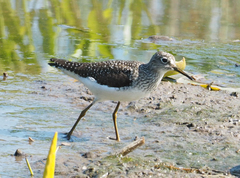
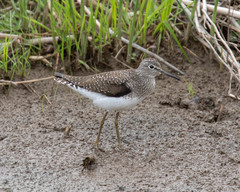
This species measures 18–23 cm (7.1–9.1 in) long, with a wingspan up to 50 cm (20 in) and a body mass of 31–65 g (1.1–2.3 oz). It is a dumpy wader with a dark green back, greyish head and breast and otherwise white underparts. It is obvious in flight, with wings dark above and below, and a dark rump and tail centre. The latter feature distinguishes it from the slightly larger and broader-winged, but otherwise very similar, green sandpiper (T. ochropus) of Europe and Asia, to which it is closely related. The latter species has a brilliant white rump. In flight, the solitary sandpiper has a characteristic three-note whistle. They both have brown wings with little light dots, and a delicate but contrasting neck and chest pattern. In addition, both species nest in trees, unlike most other scolopacids.

It breeds... Wikipedia →

Sounds

Call0:19

Brazil · 2025

© JAYRSON ARAUJO DE OLIVEIRA · XC961361 · CC BY-NC-SA 4.0

Flight call0:15

United States · 2022

© Richard E. Webster · XC774176 · CC BY-NC-SA 4.0

Alarm call0:28

Canada · 1985

© Peter Ward and Ken Hall · XC606780 · CC BY-NC-SA 4.0

Global Distribution

Parks Where Found

# Park Country Daily sighting probability
1 Wrangell-St. Elias National Park 🇺🇸 United States
~20%
2 Caroni Swamp 🇹🇹 Trinidad and Tobago
~20%
3 Elk Island National Park 🇨🇦 Canada
~10%
4 Palo Verde National Park 🇨🇷 Costa Rica
~10%
5 Isla del Coco National Park 🇨🇷 Costa Rica
~10%
6 Los Haitises National Park 🇩🇴 Dominican Republic
~10%
7 Kluane National Park 🇨🇦 Canada
~10%
8 Anavilhanas National Park 🇧🇷 Brazil
~10%
9 Wood Buffalo National Park 🇨🇦 Canada
~10%
10 El Impenetrable National Park 🇦🇷 Argentina
~10%
11 Jasper National Park 🇨🇦 Canada
~10%
12 Manu National Park 🇵🇪 Peru
~10%
13 Cuyabeno Wildlife Reserve 🇪🇨 Ecuador
~10%
14 Iberá National Park 🇦🇷 Argentina
~10%
15 Parque Estadual Encontro das Águas 🇧🇷 Brazil
~10%
16 Calakmul Biosphere Reserve 🇲🇽 Mexico
~10%
17 Denali National Park 🇺🇸 United States
<5%
18 Gandoca-Manzanillo Wildlife Refuge 🇨🇷 Costa Rica
<5%
19 Celestún Biosphere Reserve 🇲🇽 Mexico
<5%
20 Coiba National Park 🇵🇦 Panama
<5%
21 Las Baulas Marine National Park 🇨🇷 Costa Rica
<5%
22 Banff National Park 🇨🇦 Canada
<5%
23 Cabo Blanco Absolute Nature Reserve 🇨🇷 Costa Rica
<5%
24 Riding Mountain National Park 🇨🇦 Canada
<5%
25 Amacayacu National Natural Park 🇨🇴 Colombia
<5%
26 Ría Lagartos Biosphere Reserve 🇲🇽 Mexico
<5%
27 Ciénaga de Zapata 🇨🇺 Cuba
<5%
28 Soberanía National Park 🇵🇦 Panama
<5%
29 Arrecifes de Cozumel National Park 🇲🇽 Mexico
<5%
30 Piedras Blancas National Park 🇨🇷 Costa Rica
<5%
31 Tayrona National Natural Park 🇨🇴 Colombia
<5%
32 Yasuní National Park 🇪🇨 Ecuador
<5%
33 Parque Natural Metropolitano 🇵🇦 Panama
<5%
34 La Amistad International Park (Panama) 🇵🇦 Panama
<5%
35 Everglades National Park 🇺🇸 United States
<5%
36 Corcovado National Park 🇨🇷 Costa Rica
<5%
37 Tambopata National Reserve 🇵🇪 Peru
<5%
38 Tortuguero National Park 🇨🇷 Costa Rica
<5%
39 Acadia National Park 🇺🇸 United States
<5%
40 Point Pelee National Park 🇨🇦 Canada
<5%
41 Cape Breton Highlands National Park 🇨🇦 Canada
<5%
42 Carara National Park 🇨🇷 Costa Rica
<5%
43 Manuel Antonio National Park 🇨🇷 Costa Rica
<5%
44 Padre Island National Seashore 🇺🇸 United States
<5%
45 Marino Ballena National Park 🇨🇷 Costa Rica
<5%
46 Glacier National Park 🇺🇸 United States
<5%
47 Bastimentos Island National Marine Park 🇵🇦 Panama
<5%
48 Lago de Yojoa 🇭🇳 Honduras
<5%
49 Sian Ka'an Biosphere Reserve 🇲🇽 Mexico
<5%
50 Big Cypress National Preserve 🇺🇸 United States
<5%
51 Big Bend National Park 🇺🇸 United States
<5%
52 Rincón de la Vieja National Park 🇨🇷 Costa Rica
<5%
53 Cockscomb Basin Wildlife Sanctuary 🇧🇿 Belize
<5%
54 Yellowstone National Park 🇺🇸 United States
<5%
55 Merritt Island National Wildlife Refuge 🇺🇸 United States
<5%
56 Sierra de la Macarena National Park 🇨🇴 Colombia
<5%
57 Cahuita National Park 🇨🇷 Costa Rica
<5%
58 Galápagos Islands 🇪🇨 Ecuador
<5%
59 Death Valley National Park 🇺🇸 United States
<5%
60 Congaree National Park 🇺🇸 United States
<5%
61 Grand Teton National Park 🇺🇸 United States
<5%
62 Grand Canyon National Park 🇺🇸 United States
<5%
63 Braulio Carrillo National Park 🇨🇷 Costa Rica
<5%
64 Shenandoah National Park 🇺🇸 United States
<5%
65 Los Nevados National Natural Park 🇨🇴 Colombia
<5%
66 Iguaçu National Park 🇧🇷 Brazil
<5%
67 Great Bear Rainforest 🇨🇦 Canada
<5%
68 Rocky Mountain National Park 🇺🇸 United States
<5%
69 Saguaro National Park 🇺🇸 United States
<5%
70 Great Smoky Mountains National Park 🇺🇸 United States
<5%
71 Arenal Volcano National Park 🇨🇷 Costa Rica
<5%

Cities Where Found

# City Country Daily sighting probability
1 Bogota 🇨🇴 Colombia
~20%
2 Asuncion 🇵🇾 Paraguay
~10%
3 Santa Cruz de la Sierra 🇧🇴 Bolivia
~10%
4 Barranquilla 🇨🇴 Colombia
~10%
5 Santo Domingo 🇩🇴 Dominican Republic
~10%
6 Vitória 🇧🇷 Brazil
~10%
7 Maracaibo 🇻🇪 Venezuela
~10%
8 Panama City 🇵🇦 Panama
~10%
9 Goiânia 🇧🇷 Brazil
<5%
10 Calgary 🇨🇦 Canada
<5%

Before you go

What are the chances of seeing a Solitary Sandpiper in Ciénaga de Zapata?

Rare

Under 5% of wildlife watchers report a Solitary Sandpiper sighting in Ciénaga de Zapata on a given day, based on 39 verified sightings from GBIF citizen-science data from 2019 to 2026. It is the 134th most-seen of the 177 birds we can rate there. Over three days the chance rises to about 10%, and over a week to about 20%, if each day is a fresh chance.

When is the best time to see a Solitary Sandpiper in Ciénaga de Zapata?

August

In that month about 10% of wildlife watchers report a Solitary Sandpiper in Ciénaga de Zapata on a given day, against under 5% in October to July, the lowest months. That is one of Ciénaga de Zapata's wettest months, with about 130 mm of rain against 15 mm in February. September has too few records to rate.

What time of day is best to see a Solitary Sandpiper?

Between 9 am and noon

Across all the parks we cover, that three-hour window holds the most Solitary Sandpiper sightings with a recorded time, and about 9 in 10 of them come between 6 am and 6 pm: it is a daytime animal.

Is Ciénaga de Zapata the best place to see a Solitary Sandpiper?

27th of 71

Of the 71 parks where we can rate Solitary Sandpiper sightings, Ciénaga de Zapata ranks 27th at under 5%. The best odds are in Wrangell-St. Elias National Park (United States, about 20%), Caroni Swamp (Trinidad and Tobago, about 20%) and Elk Island National Park (Canada, about 10%).

Which relatives of the Solitary Sandpiper live in Ciénaga de Zapata?

Same genus: Tringa

The closest relatives of the Solitary Sandpiper that you can see in Ciénaga de Zapata (genus Tringa, Shanks, Tattlers, and Allies) are Greater Yellowlegs (about 30%), Willet (about 20%) and Lesser Yellowlegs (about 20%), with each one's daily chance of a sighting.

Where does the Solitary Sandpiper sighting chance come from?

GBIF citizen-science records

It is estimated from how often the Solitary Sandpiper is recorded against all the birds logged in Ciénaga de Zapata (39 verified sightings from 2019 to 2026), calibrated against known sighting rates. Figures are rounded to the nearest 10% because citizen-science data supports honest approximations, not decimals, and months with records from fewer than five people show "—". How it works.

← Back to Ciénaga de Zapata