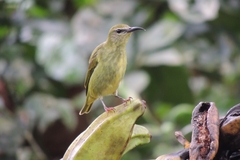
Red-legged Honeycreeper

Red-legged Honeycreeper

Cyanerpes cyaneus

Silhouette: Sheatherius · PhyloPic

LCLeast ConcernNTVUENCR
Daily sighting probability <5% · Rare
at Tayrona National Natural Park

In 3 days ~10% in a week ~20%

51 Verified sightings at Tayrona National Natural Park From 2019 to 2026
25,029 In all 57 parks
August Best month
☀️ Diurnal When it's spotted

About the Red-legged Honeycreeper

The red-legged honeycreeper (Cyanerpes cyaneus) is a small songbird in the family Thraupidae, the tanagers and allies. It is regularly found in Mexico, every Central American country, Trinidad and Tobago, and every mainland South American country except Argentina, Chile, Paraguay, and Uruguay. It has also occurred as a vagrant in the United States, Argentina, and some southern Caribbean islands.

The red-legged honeycreeper was formally described by the Swedish naturalist Carl Linnaeus in 1766 in the twelfth edition of his Systema Naturae with the binomial Certhia cyanea. Linnaeus based his description on "The Black and Blue Creeper" that had been described and illustrated in 1760 by the English naturalist George Edwards from a specimen collected in Suriname. The purple honeycreeper was named the type species of the genus Cyanerpes when the American ornithologist Harry C. Oberholser erected the genus in 1899. The specific epithet cyaneus is a Latin word meaning "dark-blue".

The purplish honeycreeper (Chlorophanes purpurascens), a bird from Venezuela known only from the type specimen, is considered to be an intergeneric hybrid between the green honeycreeper... Wikipedia →

Sounds

Call1:01

Brazil · 2025

© JAYRSON ARAUJO DE OLIVEIRA · XC1027575 · CC BY-NC-SA 4.0

Song0:46

Cuba · 2021

© Nils Navarro · XC632129 · CC BY-NC-SA 4.0

Alarm call0:40

Brazil · 2014

© Ricardo Gagliardi · XC472330 · CC BY-NC-SA 4.0

Global Distribution

Parks Where Found

# Park Country Daily sighting probability
1 Brownsberg Nature Park 🇸🇷 Suriname
~70%
2 El Triunfo 🇲🇽 Mexico
~50%
3 Arenal Volcano National Park 🇨🇷 Costa Rica
~40%
4 Chagres National Park 🇵🇦 Panama
~40%
5 Poás Volcano National Park 🇨🇷 Costa Rica
~40%
6 Coiba National Park 🇵🇦 Panama
~30%
7 Cerro Azul Meámbar National Park 🇭🇳 Honduras
~30%
8 Cockscomb Basin Wildlife Sanctuary 🇧🇿 Belize
~30%
9 Main Ridge Forest Reserve 🇹🇹 Trinidad and Tobago
~30%
10 Tenorio Volcano National Park 🇨🇷 Costa Rica
~30%
11 Carara National Park 🇨🇷 Costa Rica
~30%
12 Soberanía National Park 🇵🇦 Panama
~30%
13 Chirripó National Park 🇨🇷 Costa Rica
~20%
14 Utría National Natural Park 🇨🇴 Colombia
~20%
15 Corcovado National Park 🇨🇷 Costa Rica
~20%
16 Braulio Carrillo National Park 🇨🇷 Costa Rica
~20%
17 San Lorenzo Protected Forest 🇵🇦 Panama
~20%
18 Rincón de la Vieja National Park 🇨🇷 Costa Rica
~20%
19 Tikal National Park 🇬🇹 Guatemala
~20%
20 Marino Ballena National Park 🇨🇷 Costa Rica
~20%
21 Lago de Yojoa 🇭🇳 Honduras
~20%
22 Pico Bonito National Park 🇭🇳 Honduras
~20%
23 Piedras Blancas National Park 🇨🇷 Costa Rica
~20%
24 Cusuco National Park 🇭🇳 Honduras
~10%
25 Parque Natural Metropolitano 🇵🇦 Panama
~10%
26 Montes Azules Biosphere Reserve 🇲🇽 Mexico
~10%
27 Calakmul Biosphere Reserve 🇲🇽 Mexico
~10%
28 Monteverde Cloud Forest Reserve 🇨🇷 Costa Rica
~10%
29 La Amistad International Park (Panama) 🇵🇦 Panama
~10%
30 Darién National Park 🇵🇦 Panama
~10%
31 Manuel Antonio National Park 🇨🇷 Costa Rica
~10%
32 Chapada dos Guimarães National Park 🇧🇷 Brazil
~10%
33 Santa Rosa National Park 🇨🇷 Costa Rica
~10%
34 Cahuita National Park 🇨🇷 Costa Rica
~10%
35 Sian Ka'an Biosphere Reserve 🇲🇽 Mexico
~10%
36 Cabo Blanco Absolute Nature Reserve 🇨🇷 Costa Rica
<5%
37 Bastimentos Island National Marine Park 🇵🇦 Panama
<5%
38 Sierra de la Macarena National Park 🇨🇴 Colombia
<5%
39 Gandoca-Manzanillo Wildlife Refuge 🇨🇷 Costa Rica
<5%
40 Emas National Park 🇧🇷 Brazil
<5%
41 Tayrona National Natural Park 🇨🇴 Colombia
<5%
42 Biotopo Cerro Cahuí 🇬🇹 Guatemala
<5%
43 Ciénaga de Zapata 🇨🇺 Cuba
<5%
44 Ostional Wildlife Refuge 🇨🇷 Costa Rica
<5%
45 Volcán Barú National Park 🇵🇦 Panama
<5%
46 Henri Pittier National Park 🇻🇪 Venezuela
<5%
47 Anavilhanas National Park 🇧🇷 Brazil
<5%
48 Tortuguero National Park 🇨🇷 Costa Rica
<5%
49 Serra dos Órgãos National Park 🇧🇷 Brazil
<5%
50 Arrecifes de Cozumel National Park 🇲🇽 Mexico
<5%
51 Los Quetzales National Park 🇨🇷 Costa Rica
<5%
52 Farallones de Cali National Natural Park 🇨🇴 Colombia
<5%
53 Yasuní National Park 🇪🇨 Ecuador
<5%
54 Las Baulas Marine National Park 🇨🇷 Costa Rica
<5%
55 Palo Verde National Park 🇨🇷 Costa Rica
<5%
56 Manu National Park 🇵🇪 Peru
<5%
57 Tambopata National Reserve 🇵🇪 Peru
<5%

Cities Where Found

# City Country Daily sighting probability
1 Havana 🇨🇺 Cuba
~10%
2 Campo Grande 🇧🇷 Brazil
~10%
3 Panama City 🇵🇦 Panama
<5%
4 João Pessoa 🇧🇷 Brazil
<5%
5 Maceió 🇧🇷 Brazil
<5%
6 San Salvador 🇸🇻 El Salvador
<5%
7 San José 🇨🇷 Costa Rica
<5%
8 Guatemala City 🇬🇹 Guatemala
<5%
9 Miami 🇺🇸 United States
<5%
10 Caracas 🇻🇪 Venezuela
<5%

Zoos & Centres Where Found

# Zoo / Centre Country
1 Basel Zoo 🇨🇭 Switzerland In captivity
2 ZooParc de Beauval 🇫🇷 France In captivity
3 Tierpark Berlin 🇩🇪 Germany In captivity
4 Zoo Pilsen 🇨🇿 Czechia In captivity
5 Parc des oiseaux 🇫🇷 France In captivity
6 Omaha’s Henry Doorly Zoo and Aquarium 🇺🇸 United States In captivity
7 Toledo Zoo 🇺🇸 United States In captivity
8 Burgers' Ocean 🇳🇱 Netherlands In captivity
9 Royal Burgers' Zoo 🇳🇱 Netherlands In captivity
10 Wilhelma 🇩🇪 Germany In captivity
11 Houston Zoo 🇺🇸 United States In captivity
12 La Paz Waterfall Gardens 🇨🇷 Costa Rica In captivity
13 Aviario Nacional de Colombia 🇨🇴 Colombia In captivity
14 Universeum 🇸🇪 Sweden In captivity
15 Key West Butterfly and Nature Conservatory 🇺🇸 United States In captivity
16 Butterfly World 🇺🇸 United States In captivity

Before you go

What are the chances of seeing a Red-legged Honeycreeper in Tayrona National Natural Park?

Rare

Under 5% of wildlife watchers report a Red-legged Honeycreeper sighting in Tayrona National Natural Park on a given day, based on 51 verified sightings from GBIF citizen-science data from 2019 to 2026. It is the 149th most-seen of the 285 birds we can rate there. Over three days the chance rises to about 10%, and over a week to about 20%, if each day is a fresh chance.

When is the best time to see a Red-legged Honeycreeper in Tayrona National Natural Park?

August

In that month about 20% of wildlife watchers report a Red-legged Honeycreeper in Tayrona National Natural Park on a given day, against under 5% in June and October–April, the lowest months. That is one of Tayrona National Natural Park's wettest months, with about 150 mm of rain against 5 mm in January.

What time of day is best to see a Red-legged Honeycreeper?

Between 7 and 10 am

Across all the parks we cover, that three-hour window holds the most Red-legged Honeycreeper sightings with a recorded time, and about 9 in 10 of them come between 6 am and 6 pm: it is a daytime animal.

Is Tayrona National Natural Park the best place to see a Red-legged Honeycreeper?

41st of 57

Of the 57 parks where we can rate Red-legged Honeycreeper sightings, Tayrona National Natural Park ranks 41st at under 5%. The best odds are in Brownsberg Nature Park (Suriname, about 70%), El Triunfo (Mexico, about 50%) and Arenal Volcano National Park (Costa Rica, about 40%). All parks ranked.

Where does the Red-legged Honeycreeper sighting chance come from?

GBIF citizen-science records

It is estimated from how often the Red-legged Honeycreeper is recorded against all the birds logged in Tayrona National Natural Park (51 verified sightings from 2019 to 2026), calibrated against known sighting rates. Figures are rounded to the nearest 10% because citizen-science data supports honest approximations, not decimals, and months with records from fewer than five people show "—". How it works.

← Back to Tayrona National Natural Park