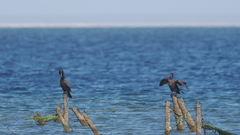
Bigua cormorant

Bigua cormorant

Phalacrocorax brasilianus

Silhouette: Jefry Saavedra-Gutiérrez · PhyloPic

LCLeast ConcernNTVUENCR
Daily sighting probability ~20% · Possible
at Campinas

In 3 days ~50% in a week ~80%

101 Verified sightings at Campinas
23,737 In all 77 parks From 2019 to 2026
April Best month
☀️ Diurnal When it's spotted

About the Bigua cormorant

The neotropic cormorant or olivaceous cormorant (Nannopterum brasilianum) is a medium-sized cormorant found throughout the American tropics and subtropics, from the middle Rio Grande and the Gulf and Californian coasts of the United States south through Mexico and Central America to southern South America, where it is called by the indigenous name of biguá. It also breeds in the Bahamas, Cuba, and Trinidad. It can be found both on coasts (including some mangrove areas) and in inland waters. In Peru, the neotropic cormorant is used by the Uru people for fishing.

The neotropic cormorant was documented in 1658 by the Dutch naturalist Willem Piso after travels in Brazil. This formed the basis for the formal description and naming of the species by Johann Friedrich Gmelin in 1789. He placed it with the petrels in the genus Procellaria and coined the binomial name Procellaria brasiliana. Many authors preferred to use Alexander von Humboldt's 1805 description of Pelecanus olivaceus because the identity of Piso's birds was considered uncertain. Later, ornithological... Wikipedia →

Sounds

Recording0:10

United States · 2021

© jo12345 · iNaturalist · CC BY-NC 4.0

Recording0:35

Peru · 2021

© Leo B · iNaturalist · CC BY-NC 4.0

Recording0:16

Mexico · 2023

© medina_andrea_ico_3a · iNaturalist · CC BY-NC 4.0

Global Distribution

Parks Where Found

# Park Country Daily sighting probability
1 Parque Estadual Encontro das Águas 🇧🇷 Brazil
~80%
2 Península Valdés 🇦🇷 Argentina
~80%
3 Ría Lagartos Biosphere Reserve 🇲🇽 Mexico
~60%
4 Nahuel Huapi National Park 🇦🇷 Argentina
~50%
5 Iberá National Park 🇦🇷 Argentina
~40%
6 Celestún Biosphere Reserve 🇲🇽 Mexico
~40%
7 Ciénaga de Zapata 🇨🇺 Cuba
~40%
8 Vicente Pérez Rosales National Park 🇨🇱 Chile
~40%
9 Anavilhanas National Park 🇧🇷 Brazil
~40%
10 Iguaçu National Park 🇧🇷 Brazil
~30%
11 Lauca National Park 🇨🇱 Chile
~30%
12 Carara National Park 🇨🇷 Costa Rica
~30%
13 Biotopo Cerro Cahuí 🇬🇹 Guatemala
~30%
14 Ostional Wildlife Refuge 🇨🇷 Costa Rica
~30%
15 Utría National Natural Park 🇨🇴 Colombia
~30%
16 Tortuguero National Park 🇨🇷 Costa Rica
~30%
17 Iguazú National Park 🇦🇷 Argentina
~30%
18 Caroni Swamp 🇹🇹 Trinidad and Tobago
~30%
19 Cuyabeno Wildlife Reserve 🇪🇨 Ecuador
~30%
20 Montes Azules Biosphere Reserve 🇲🇽 Mexico
~20%
21 Tierra del Fuego National Park 🇦🇷 Argentina
~20%
22 Manu National Park 🇵🇪 Peru
~20%
23 Las Baulas Marine National Park 🇨🇷 Costa Rica
~20%
24 Tijuca National Park 🇧🇷 Brazil
~20%
25 Bastimentos Island National Marine Park 🇵🇦 Panama
~20%
26 Tambopata National Reserve 🇵🇪 Peru
~20%
27 Amacayacu National Natural Park 🇨🇴 Colombia
~20%
28 Cañón del Sumidero National Park 🇲🇽 Mexico
~10%
29 Sian Ka'an Biosphere Reserve 🇲🇽 Mexico
~10%
30 El Impenetrable National Park 🇦🇷 Argentina
~10%
31 San Lorenzo Protected Forest 🇵🇦 Panama
~10%
32 Machalilla National Park 🇪🇨 Ecuador
~10%
33 La Amistad International Park (Panama) 🇵🇦 Panama
~10%
34 Lago de Yojoa 🇭🇳 Honduras
~10%
35 Cabo Blanco Absolute Nature Reserve 🇨🇷 Costa Rica
~10%
36 Palo Verde National Park 🇨🇷 Costa Rica
~10%
37 Darién National Park 🇵🇦 Panama
~10%
38 Marino Ballena National Park 🇨🇷 Costa Rica
~10%
39 Padre Island National Seashore 🇺🇸 United States
~10%
40 El Triunfo 🇲🇽 Mexico
~10%
41 Gandoca-Manzanillo Wildlife Refuge 🇨🇷 Costa Rica
~10%
42 Chagres National Park 🇵🇦 Panama
~10%
43 El Palmar National Park 🇦🇷 Argentina
~10%
44 Parque Natural Metropolitano 🇵🇦 Panama
~10%
45 Santa Rosa National Park 🇨🇷 Costa Rica
~10%
46 Henri Pittier National Park 🇻🇪 Venezuela
~10%
47 Braulio Carrillo National Park 🇨🇷 Costa Rica
~10%
48 Tayrona National Natural Park 🇨🇴 Colombia
~10%
49 Soberanía National Park 🇵🇦 Panama
~10%
50 Coiba National Park 🇵🇦 Panama
~10%
51 Everglades National Park 🇺🇸 United States
<5%
52 Yasuní National Park 🇪🇨 Ecuador
<5%
53 Arenal Volcano National Park 🇨🇷 Costa Rica
<5%
54 Cahuita National Park 🇨🇷 Costa Rica
<5%
55 Cerro Azul Meámbar National Park 🇭🇳 Honduras
<5%
56 Pico Bonito National Park 🇭🇳 Honduras
<5%
57 Corcovado National Park 🇨🇷 Costa Rica
<5%
58 Manuel Antonio National Park 🇨🇷 Costa Rica
<5%
59 Torres del Paine National Park 🇨🇱 Chile
<5%
60 Arrecifes de Cozumel National Park 🇲🇽 Mexico
<5%
61 Piedras Blancas National Park 🇨🇷 Costa Rica
<5%
62 Bahía de Loreto National Park 🇲🇽 Mexico
<5%
63 Serra dos Órgãos National Park 🇧🇷 Brazil
<5%
64 Cumbres de Monterrey National Park 🇲🇽 Mexico
<5%
65 Chapada dos Guimarães National Park 🇧🇷 Brazil
<5%
66 Los Nevados National Natural Park 🇨🇴 Colombia
<5%
67 Farallones de Cali National Natural Park 🇨🇴 Colombia
<5%
68 Sierra de la Macarena National Park 🇨🇴 Colombia
<5%
69 Cockscomb Basin Wildlife Sanctuary 🇧🇿 Belize
<5%
70 Saguaro National Park 🇺🇸 United States
<5%
71 Poás Volcano National Park 🇨🇷 Costa Rica
<5%
72 Tenorio Volcano National Park 🇨🇷 Costa Rica
<5%
73 Itatiaia National Park 🇧🇷 Brazil
<5%
74 Point Pelee National Park 🇨🇦 Canada
<5%
75 Volcán Barú National Park 🇵🇦 Panama
<5%
76 Tapantí-Macizo de la Muerte National Park 🇨🇷 Costa Rica
<5%
77 Big Bend National Park 🇺🇸 United States
<5%

Cities Where Found

# City Country Daily sighting probability
1 Barranquilla 🇨🇴 Colombia
~50%
2 León 🇲🇽 México
~50%
3 São Luís 🇧🇷 Brazil
~50%
4 Mesa 🇺🇸 United States
~50%
5 Buenos Aires 🇦🇷 Argentina
~40%
6 Panama City 🇵🇦 Panama
~40%
7 Montevideo 🇺🇾 Uruguay
~40%
8 Santa Cruz de la Sierra 🇧🇴 Bolivia
~40%
9 Lima 🇵🇪 Peru
~40%
10 Vitória 🇧🇷 Brazil
~30%

Zoos & Centres Where Found

# Zoo / Centre Country
1 San Diego Zoo 🇺🇸 United States In captivity
2 Abilene Zoological Gardens 🇺🇸 United States In captivity
3 Zoológico de Brasília 🇧🇷 Brazil In captivity
4 Parque Municipal Summit 🇵🇦 Panama In captivity
5 Temaikén 🇦🇷 Argentina In captivity
6 Bioparque Municipal Vesty Pakos 🇧🇴 Bolivia In captivity
7 Ecopark 🇦🇷 Argentina In captivity
8 Aviario Nacional de Colombia 🇨🇴 Colombia In captivity
9 The Abilene Zoo 🇺🇸 United States In captivity
10 Mangal das Garças 🇧🇷 Brazil In captivity
11 Parque Zoobotânico de Joinville 🇧🇷 Brazil In captivity
12 Parque Zoobotânico Orquidário Municipal de Santos 🇧🇷 Brazil In captivity
13 Zoológico del Parque de la Exposición 🇵🇪 Peru In captivity

Before you go

What are the chances of seeing a Bigua cormorant in Campinas?

Possible

About 20% of wildlife watchers report a Bigua cormorant sighting in Campinas on a given day, based on 101 verified sightings from GBIF citizen-science data. It is the 27th most-seen of the 149 birds we can rate there. Over three days the chance rises to about 50%, and over a week to about 80%, if each day is a fresh chance.

When is the best time to see a Bigua cormorant in Campinas?

April

In that month about 40% of wildlife watchers report a Bigua cormorant in Campinas on a given day, against about 10% in March, the lowest month.

What time of day is best to see a Bigua cormorant?

Between 8 and 11 am

Across all the parks we cover, that three-hour window holds the most Bigua cormorant sightings with a recorded time, and about 9 in 10 of them come between 6 am and 6 pm: it is a daytime animal.

Is Campinas the best place to see a Bigua cormorant?

20th of 64

Of the 64 cities where we can rate Bigua cormorant sightings, Campinas ranks 20th at about 20%. The best odds are in Barranquilla (Colombia, about 50%), León (México, about 50%) and São Luís (Brazil, about 50%).

Where does the Bigua cormorant sighting chance come from?

GBIF citizen-science records

It is estimated from how often the Bigua cormorant is recorded against all the birds logged in Campinas (101 verified sightings), calibrated against known sighting rates. Figures are rounded to the nearest 10% because citizen-science data supports honest approximations, not decimals, and months with records from fewer than five people show "—". How it works.

← Back to Campinas