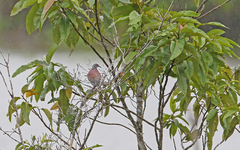
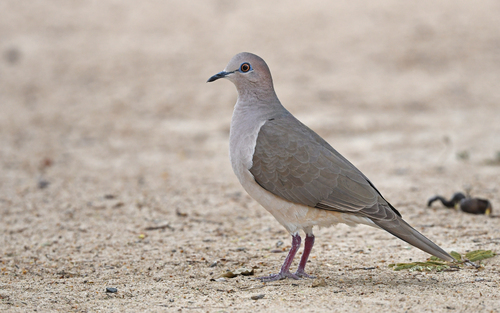
Pale-vented Pigeon

Pale-vented Pigeon

Patagioenas cayennensis

Silhouette: Ferran Sayol · PhyloPic

LCLeast ConcernNTVUENCR
Daily sighting probability <5% · Rare
at Tikal National Park

In 3 days ~10% in a week ~20%

49 Verified sightings at Tikal National Park From 2019 to 2026
27,909 In all 59 parks
June Best month
☀️ Diurnal When it's spotted

About the Pale-vented Pigeon

The pale-vented pigeon (Patagioenas cayennensis) is a large pigeon (family Columbidae) found in the tropical Americas. Formerly often placed in Columba, it actually belongs to a clade of the older New World genus Patagioenas. With its relatives it represents an evolutionary radiation extending through most of the warm-temperate to tropical Americas. Grey-hued birds, even their males generally lack iridescent display plumage, although the present species has some coppery gloss on the nape.

It is a resident breeder from southern Mexico south to Bolivia and northern Argentina and on Tobago and Trinidad, although it is very localised on the latter island. Vagrants are occasionally seen in adjacent regions; for example, the species is noted to stray into Uruguay from Argentina and occasionally from Brazil, but it has never been noted to breed or even maintain a permanent presence in the former country.

The pale-vented pigeon is 30–32 cm long and weighs normally 230–250 g. Adult males have a mainly dull purple head, breast and upperpart plumage, with copper glossing on the nape and a whitish throat. The lower back and tail are dark grey and the lower underparts are pale... Wikipedia →

Sounds

Territorial or courtship call0:16

Ecuador · 2025

© Manuel Sánchez-Nivicela · XC1177562 · CC BY-NC-ND 4.0

Song0:34

Brazil · 2026

© JAYRSON ARAUJO DE OLIVEIRA · XC1163642 · CC BY-NC-SA 4.0

Call0:22

Ecuador · 1994

© John V. Moore · XC257597 · CC BY-NC-SA 4.0

Global Distribution

Parks Where Found

# Park Country Daily sighting probability
1 Parque Estadual Encontro das Águas 🇧🇷 Brazil
~60%
2 Bastimentos Island National Marine Park 🇵🇦 Panama
~60%
3 Main Ridge Forest Reserve 🇹🇹 Trinidad and Tobago
~50%
4 Soberanía National Park 🇵🇦 Panama
~50%
5 Gandoca-Manzanillo Wildlife Refuge 🇨🇷 Costa Rica
~40%
6 Emas National Park 🇧🇷 Brazil
~40%
7 Tortuguero National Park 🇨🇷 Costa Rica
~40%
8 Coiba National Park 🇵🇦 Panama
~40%
9 Utría National Natural Park 🇨🇴 Colombia
~30%
10 Parque Natural Metropolitano 🇵🇦 Panama
~30%
11 Piedras Blancas National Park 🇨🇷 Costa Rica
~30%
12 Anavilhanas National Park 🇧🇷 Brazil
~30%
13 Cahuita National Park 🇨🇷 Costa Rica
~30%
14 Cuyabeno Wildlife Reserve 🇪🇨 Ecuador
~30%
15 La Amistad International Park (Panama) 🇵🇦 Panama
~30%
16 Manuel Antonio National Park 🇨🇷 Costa Rica
~30%
17 Cockscomb Basin Wildlife Sanctuary 🇧🇿 Belize
~30%
18 Serra da Canastra National Park 🇧🇷 Brazil
~20%
19 Sierra de la Macarena National Park 🇨🇴 Colombia
~20%
20 Montes Azules Biosphere Reserve 🇲🇽 Mexico
~20%
21 Yasuní National Park 🇪🇨 Ecuador
~20%
22 Chapada Diamantina National Park 🇧🇷 Brazil
~20%
23 Manu National Park 🇵🇪 Peru
~20%
24 Cerro Azul Meámbar National Park 🇭🇳 Honduras
~20%
25 Corcovado National Park 🇨🇷 Costa Rica
~20%
26 Machalilla National Park 🇪🇨 Ecuador
~20%
27 Amacayacu National Natural Park 🇨🇴 Colombia
~10%
28 Marino Ballena National Park 🇨🇷 Costa Rica
~10%
29 Lago de Yojoa 🇭🇳 Honduras
~10%
30 Iguazú National Park 🇦🇷 Argentina
~10%
31 San Lorenzo Protected Forest 🇵🇦 Panama
~10%
32 Iguaçu National Park 🇧🇷 Brazil
~10%
33 Tambopata National Reserve 🇵🇪 Peru
~10%
34 Henri Pittier National Park 🇻🇪 Venezuela
~10%
35 Chapada dos Guimarães National Park 🇧🇷 Brazil
~10%
36 Pico Bonito National Park 🇭🇳 Honduras
~10%
37 Chagres National Park 🇵🇦 Panama
~10%
38 Braulio Carrillo National Park 🇨🇷 Costa Rica
~10%
39 Darién National Park 🇵🇦 Panama
~10%
40 Arenal Volcano National Park 🇨🇷 Costa Rica
~10%
41 Biotopo Cerro Cahuí 🇬🇹 Guatemala
<5%
42 El Impenetrable National Park 🇦🇷 Argentina
<5%
43 Farallones de Cali National Natural Park 🇨🇴 Colombia
<5%
44 Caroni Swamp 🇹🇹 Trinidad and Tobago
<5%
45 Tikal National Park 🇬🇹 Guatemala
<5%
46 Volcán Barú National Park 🇵🇦 Panama
<5%
47 Los Nevados National Natural Park 🇨🇴 Colombia
<5%
48 Tayrona National Natural Park 🇨🇴 Colombia
<5%
49 Calakmul Biosphere Reserve 🇲🇽 Mexico
<5%
50 Serra dos Órgãos National Park 🇧🇷 Brazil
<5%
51 Amboró National Park 🇧🇴 Bolivia
<5%
52 Itatiaia National Park 🇧🇷 Brazil
<5%
53 Cusuco National Park 🇭🇳 Honduras
<5%
54 Carara National Park 🇨🇷 Costa Rica
<5%
55 Iberá National Park 🇦🇷 Argentina
<5%
56 Tenorio Volcano National Park 🇨🇷 Costa Rica
<5%
57 Rincón de la Vieja National Park 🇨🇷 Costa Rica
<5%
58 Chirripó National Park 🇨🇷 Costa Rica
<5%
59 Poás Volcano National Park 🇨🇷 Costa Rica
<5%

Cities Where Found

# City Country Daily sighting probability
1 Panama City 🇵🇦 Panama
~40%
2 Guayaquil 🇪🇨 Ecuador
~30%
3 Belém 🇧🇷 Brazil
~30%
4 Campo Grande 🇧🇷 Brazil
~20%
5 Goiânia 🇧🇷 Brazil
~20%
6 San Pedro Sula 🇭🇳 Honduras
~10%
7 Manaus 🇧🇷 Brazil
~10%
8 Brasilia 🇧🇷 Brazil
~10%
9 Valencia 🇻🇪 Venezuela
~10%
10 Barranquilla 🇨🇴 Colombia
~10%

Zoos & Centres Where Found

# Zoo / Centre Country
1 Aviario Nacional de Colombia 🇨🇴 Colombia In captivity
2 El Nispero Zoo 🇵🇦 Panama In captivity

Before you go

What are the chances of seeing a Pale-vented Pigeon in Tikal National Park?

Rare

Under 5% of wildlife watchers report a Pale-vented Pigeon sighting in Tikal National Park on a given day, based on 49 verified sightings from GBIF citizen-science data from 2019 to 2026. It is the 199th most-seen of the 300 birds we can rate there. Over three days the chance rises to about 10%, and over a week to about 20%, if each day is a fresh chance.

When is the best time to see a Pale-vented Pigeon in Tikal National Park?

June

In that month about 20% of wildlife watchers report a Pale-vented Pigeon in Tikal National Park on a given day, against under 5% in July–September and November–April, the lowest months. That is one of Tikal National Park's wettest months, with about 190 mm of rain against 30 mm in February.

What time of day is best to see a Pale-vented Pigeon?

Between 6 and 9 am

Across all the parks we cover, that three-hour window holds the most Pale-vented Pigeon sightings with a recorded time, and about 8 in 10 of them come between 6 am and 6 pm: it is a daytime animal.

Which relatives of the Pale-vented Pigeon live in Tikal National Park?

Same genus: Patagioenas

The closest relatives of the Pale-vented Pigeon that you can see in Tikal National Park (genus Patagioenas, New World Pigeons) are Short-billed Pigeon (about 30%) and Scaled Pigeon (about 10%), with each one's daily chance of a sighting.

Where does the Pale-vented Pigeon sighting chance come from?

GBIF citizen-science records

It is estimated from how often the Pale-vented Pigeon is recorded against all the birds logged in Tikal National Park (49 verified sightings from 2019 to 2026), calibrated against known sighting rates. Figures are rounded to the nearest 10% because citizen-science data supports honest approximations, not decimals, and months with records from fewer than five people show "—". How it works.

← Back to Tikal National Park