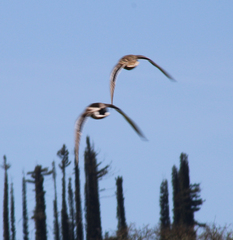

Mallard

Mallard

Anas platyrhynchos

Silhouette: Sheatherius · PhyloPic

LCLeast ConcernNTVUENCR
Daily sighting probability <5% · Rare
at Shenandoah National Park

In 3 days ~10% in a week ~30%

262 Verified sightings at Shenandoah National Park From 2019 to 2026
66,004 In all 91 parks
December Best month
☀️ Diurnal When it's spotted

About the Mallard

The mallard or wild duck (Anas platyrhynchos) is a dabbling duck that breeds throughout the temperate and subtropical Americas, Eurasia, and North Africa. It has been introduced to New Zealand, Australia, Peru, Brazil, Uruguay, Argentina, Chile, Colombia, the Falkland Islands, and South Africa. Belonging to the subfamily Anatinae of the waterfowl family Anatidae, mallards live in wetlands, eat water plants and small animals, and are social animals preferring to congregate in groups or flocks of varying sizes.

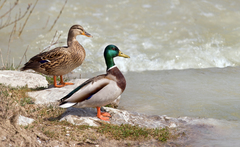
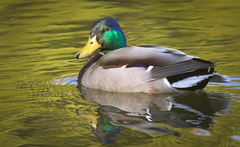
Males (drakes) have green heads, while the females (ducks) have mainly brown-speckled plumage. Both sexes have an area of white-bordered black or iridescent purple or blue feathers called a speculum on their wings; males especially tend to have blue speculum feathers. The mallard is 50–65 cm (20–26 in) long, of which the body makes up around two-thirds the length. The wingspan is 81–98 cm (32–39 in) and the bill is 4.4 to 6.1 cm (1.7 to 2.4 in) long. It is often slightly heavier than most other dabbling ducks, weighing 0.7–1.6 kg (1.5–3.5 lb).

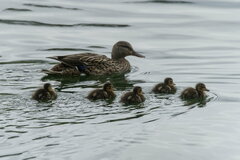
The female lays 8 to 13 creamy white to greenish-buff spotless eggs, on alternate days. Incubation takes 27 to 28 days and fledging takes 50 to 60 days. The ducklings are precocial and fully capable of swimming as soon as they hatch.

The non-migratory mallard interbreeds with indigenous wild ducks of closely related species through genetic pollution by producing fertile offspring. Complete hybridisation of various species of wild duck gene pools could result in the extinction of many indigenous waterfowl. This species is the main ancestor of most breeds of domestic duck, and its naturally evolved wild gene pool has been genetically polluted by the domestic and feral mallard populations.

The mallard is considered to be a species of least concern by the International Union for Conservation of Nature (IUCN), and, unlike many waterfowl, is considered an invasive species in some regions. It is a very adaptable species, being able to live and even thrive in urban areas which may have supported more localised, sensitive species of waterfowl before development. Wikipedia →

Sounds

Call0:21

China · 2026

© Peter Boesman · XC1147355 · CC BY-NC-ND 4.0

Flight call0:11

Mongolia · 2025

© Ding Li Yong · XC999260 · CC BY-NC-ND 4.0

Uncertain0:19

Hungary · 2025

© Garai József · XC980458 · CC BY-NC-SA 4.0

Global Distribution

Parks Where Found

# Park Country Daily sighting probability
1 Elk Island National Park 🇨🇦 Canada
~80%
2 Kiskunság National Park 🇭🇺 Hungary
~70%
3 Doñana National Park 🇪🇸 Spain
~70%
4 Plitvice Lakes National Park 🇭🇷 Croatia
~70%
5 Hortobágy National Park 🇭🇺 Hungary
~70%
6 Camargue 🇫🇷 France
~70%
7 Wadden Sea National Park 🇩🇪 Germany
~60%
8 Biebrza National Park 🇵🇱 Poland
~60%
9 Channel Islands National Park 🇺🇸 United States
~60%
10 Snowdonia National Park 🇬🇧 United Kingdom
~60%
11 Katmai National Park 🇺🇸 United States
~60%
12 Fertő-Hanság National Park 🇭🇺 Hungary
~60%
13 Cairngorms National Park 🇬🇧 United Kingdom
~60%
14 Bavarian Forest National Park 🇩🇪 Germany
~50%
15 Nikko National Park 🇯🇵 Japan
~50%
16 Gauja National Park 🇱🇻 Latvia
~50%
17 Yellowstone National Park 🇺🇸 United States
~50%
18 Białowieża National Park 🇵🇱 Poland
~50%
19 Voyageurs National Park 🇺🇸 United States
~50%
20 Triglav National Park 🇸🇮 Slovenia
~50%
21 Point Pelee National Park 🇨🇦 Canada
~40%
22 Riding Mountain National Park 🇨🇦 Canada
~40%
23 Grand Teton National Park 🇺🇸 United States
~40%
24 Rocky Mountain National Park 🇺🇸 United States
~40%
25 Fiordland National Park 🇳🇿 New Zealand
~40%
26 Sierra de Guadarrama National Park 🇪🇸 Spain
~30%
27 Acadia National Park 🇺🇸 United States
~30%
28 Banff National Park 🇨🇦 Canada
~30%
29 Monfragüe National Park 🇪🇸 Spain
~30%
30 Abel Tasman National Park 🇳🇿 New Zealand
~30%
31 Kaziranga National Park 🇮🇳 India
~30%
32 Sierra Nevada National Park 🇪🇸 Spain
~30%
33 Wrangell-St. Elias National Park 🇺🇸 United States
~30%
34 Great Bear Rainforest 🇨🇦 Canada
~30%
35 Kluane National Park 🇨🇦 Canada
~30%
36 Wood Buffalo National Park 🇨🇦 Canada
~30%
37 Isle Royale National Park 🇺🇸 United States
~30%
38 Jasper National Park 🇨🇦 Canada
~30%
39 Yosemite National Park 🇺🇸 United States
~20%
40 Tatra National Park 🇸🇰 Slovakia
~20%
41 Aigüestortes National Park 🇪🇸 Spain
~20%
42 Jiuzhaigou National Park 🇨🇳 China
~20%
43 Zion National Park 🇺🇸 United States
~20%
44 Vatnajokull National Park 🇮🇸 Iceland
~20%
45 Mercantour National Park 🇫🇷 France
~20%
46 Egmont National Park 🇳🇿 New Zealand
~20%
47 Minneriya National Park 🇱🇰 Sri Lanka
~20%
48 Olympic National Park 🇺🇸 United States
~20%
49 Glacier National Park 🇺🇸 United States
~20%
50 Pacific Rim National Park Reserve 🇨🇦 Canada
~10%
51 Redwood National Park 🇺🇸 United States
~10%
52 Death Valley National Park 🇺🇸 United States
~10%
53 Pyrénées National Park 🇫🇷 France
~10%
54 Rakiura National Park 🇳🇿 New Zealand
~10%
55 Badlands National Park 🇺🇸 United States
~10%
56 Denali National Park 🇺🇸 United States
~10%
57 Grand Canyon National Park 🇺🇸 United States
~10%
58 Vanoise National Park 🇫🇷 France
~10%
59 Gros Morne National Park 🇨🇦 Canada
~10%
60 Aoraki Mount Cook National Park 🇳🇿 New Zealand
~10%
61 La Amistad International Park (Panama) 🇵🇦 Panama
~10%
62 Cape Breton Highlands National Park 🇨🇦 Canada
~10%
63 Picos de Europa National Park 🇪🇸 Spain
~10%
64 Cévennes National Park 🇫🇷 France
~10%
65 Nahuel Huapi National Park 🇦🇷 Argentina
~10%
66 Royal National Park 🇦🇺 Australia
~10%
67 Saguaro National Park 🇺🇸 United States
<5%
68 Shenandoah National Park 🇺🇸 United States
<5%
69 Great Smoky Mountains National Park 🇺🇸 United States
<5%
70 Keoladeo National Park 🇮🇳 India
<5%
71 Joshua Tree National Park 🇺🇸 United States
<5%
72 Chitwan National Park 🇳🇵 Nepal
<5%
73 Sequoia and Kings Canyon National Parks 🇺🇸 United States
<5%
74 Merritt Island National Wildlife Refuge 🇺🇸 United States
<5%
75 Arthur's Pass National Park 🇳🇿 New Zealand
<5%
76 Royal Bardia National Park 🇳🇵 Nepal
<5%
77 Cabo Blanco Absolute Nature Reserve 🇨🇷 Costa Rica
<5%
78 Table Mountain National Park 🇿🇦 South Africa
<5%
79 Big Bend National Park 🇺🇸 United States
<5%
80 Kenai Fjords National Park 🇺🇸 United States
<5%
81 Blue Mountains National Park 🇦🇺 Australia
<5%
82 Congaree National Park 🇺🇸 United States
<5%
83 Padre Island National Seashore 🇺🇸 United States
<5%
84 El Vizcaíno Biosphere Reserve 🇲🇽 Mexico
<5%
85 Cumbres de Monterrey National Park 🇲🇽 Mexico
<5%
86 Jim Corbett National Park 🇮🇳 India
<5%
87 Chagres National Park 🇵🇦 Panama
<5%
88 Ranthambore National Park 🇮🇳 India
<5%
89 Everglades National Park 🇺🇸 United States
<5%
90 Doi Inthanon National Park 🇹🇭 Thailand
<5%
91 Los Nevados National Natural Park 🇨🇴 Colombia
<5%

Cities Where Found

# City Country Daily sighting probability
1 Kharkiv 🇺🇦 Ukraine
~90%
2 Calgary 🇨🇦 Canada
~80%
3 Amsterdam 🇳🇱 Netherlands
~80%
4 Anchorage 🇺🇸 United States
~80%
5 Minsk 🇧🇾 Belarus
~80%
6 Turin 🇮🇹 Italy
~80%
7 Liverpool 🇬🇧 United Kingdom
~80%
8 Copenhagen 🇩🇰 Denmark
~80%
9 Kyiv 🇺🇦 Ukraine
~80%
10 Bucharest 🇷🇴 Romania
~80%

Zoos & Centres Where Found

# Zoo / Centre Country
1 Disney's Animal Kingdom 🇺🇸 United States In captivity
2 San Diego Zoo 🇺🇸 United States In captivity
3 Prague Zoo 🇨🇿 Czechia In captivity
4 National Zoological Park 🇺🇸 United States In captivity
5 ZooParc de Beauval 🇫🇷 France In captivity
6 Copenhagen Zoo 🇩🇰 Denmark In captivity
7 Skansen 🇸🇪 Sweden In captivity
8 Dublin Zoo 🇮🇪 Ireland In captivity
9 Cleveland Metroparks Zoo 🇺🇸 United States In captivity
10 Cincinnati Zoo and Botanical Garden 🇺🇸 United States In captivity
11 Zürich Zoo 🇨🇭 Switzerland In captivity
12 Dresden Zoo 🇩🇪 Germany In captivity
13 Barcelona Zoo 🇪🇸 Spain In captivity
14 Ostrava Zoo 🇨🇿 Czechia In captivity
15 Parc Phœnix 🇫🇷 France In captivity
16 Muséum de Besançon 🇫🇷 France In captivity
17 Parc des oiseaux 🇫🇷 France In captivity
18 Abilene Zoological Gardens 🇺🇸 United States In captivity
19 Kaliningrad Zoo 🇷🇺 Russia In captivity
20 Zoopark Vyškov 🇨🇿 Czechia In captivity
21 Ecomuseum Zoo 🇨🇦 Canada In captivity
22 Civic Aquarium of Milan 🇮🇹 Italy In captivity
23 Nordens Ark 🇸🇪 Sweden In captivity
24 Heinola bird sanctuary 🇫🇮 Finland In captivity
25 Zoo d'Amiens 🇫🇷 France In captivity
26 Parc animalier de Merlet 🇫🇷 France In captivity
27 Gazipur Safari Park 🇧🇩 Bangladesh In captivity
28 Dalian forest zoo 🇨🇳 China In captivity
29 San Diego Zoo Safari Park 🇺🇸 United States In captivity
30 Whipsnade Zoo 🇬🇧 United Kingdom In captivity
31 Beijing Wildlife Park 🇨🇳 China In captivity
32 Safari West 🇺🇸 United States In captivity
33 Columbus Zoo and Aquarium 🇺🇸 United States In captivity
34 Grant's Farm 🇺🇸 United States In captivity
35 Bronx Zoo 🇺🇸 United States In captivity
36 Hainan Tropical Wildlife Park and Botanical Garden 🇨🇳 China In captivity
37 Yumka' 🇲🇽 Mexico In captivity
38 Candaba Bird Sanctuary 🇵🇭 Philippines In captivity
39 Ecological Center of Sonora 🇲🇽 Mexico In captivity
40 Beijing Zoo 🇨🇳 China In captivity
41 Changchun Zoological and Botanical Park 🇨🇳 China In captivity
42 Shanghai Zoo 🇨🇳 China In captivity
43 Sedgwick County Zoo 🇺🇸 United States In captivity
44 江苏淹城野生动物世界 🇨🇳 China In captivity
45 Chester Zoo 🇬🇧 United Kingdom In captivity
46 Eekholt Wildlife Park 🇩🇪 Germany In captivity
47 Orana Wildlife Park 🇳🇿 New Zealand In captivity
48 Parque Zoológico de León - Zooleón 🇲🇽 Mexico In captivity
49 Slimbridge Wetland Centre 🇬🇧 United Kingdom In captivity
50 Toledo Zoo 🇺🇸 United States In captivity

Before you go

What are the chances of seeing a Mallard in Shenandoah National Park?

Rare

Under 5% of wildlife watchers report a Mallard sighting in Shenandoah National Park on a given day, based on 262 verified sightings from GBIF citizen-science data from 2019 to 2026. It is the 89th most-seen of the 186 birds we can rate there. Over three days the chance rises to about 10%, and over a week to about 30%, if each day is a fresh chance.

When is the best time to see a Mallard in Shenandoah National Park?

November to April

In those months about 10% of wildlife watchers report a Mallard in Shenandoah National Park on a given day, against under 5% in May to October, the lowest months.

What time of day is best to see a Mallard?

Between 11 am and 2 pm

Across all the parks we cover, that three-hour window holds the most Mallard sightings with a recorded time, and about 9 in 10 of them come between 6 am and 6 pm: it is a daytime animal.

Where does the Mallard sighting chance come from?

GBIF citizen-science records

It is estimated from how often the Mallard is recorded against all the birds logged in Shenandoah National Park (262 verified sightings from 2019 to 2026), calibrated against known sighting rates. Figures are rounded to the nearest 10% because citizen-science data supports honest approximations, not decimals, and months with records from fewer than five people show "—". How it works.

← Back to Shenandoah National Park