


Completed

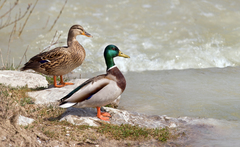
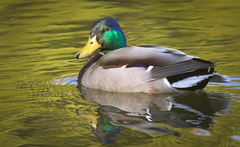
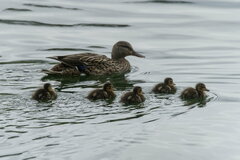

Mallard
Anas platyrhynchos
Silhouette: Sheatherius · PhyloPic
- KingdomAnimalia (Animals)
- PhylumChordata (Chordates)
- ClassAves (Birds)
- OrderAnseriformes (Waterfowl)
- FamilyAnatidae (Ducks, Geese, and Swans)
- GenusAnas (Mallards, Pintails, and Allies)
- SpeciesAnas platyrhynchos (Mallard)
In 3 days ~60% in a week ~90%
60 Verified sightings at Wrangell-St. Elias National Park From 2019 to 2026
66,004 In all 91 parks
September Best month
☀️ Diurnal When it's spotted
About the Mallard
The mallard or wild duck (Anas platyrhynchos) is a dabbling duck that breeds throughout the temperate and subtropical Americas, Eurasia, and North Africa. It has been introduced to New Zealand, Australia, Peru, Brazil, Uruguay, Argentina, Chile, Colombia, the Falkland Islands, and South Africa. Belonging to the subfamily Anatinae of the waterfowl family Anatidae, mallards live in wetlands, eat water plants and small animals, and are social animals preferring to congregate in groups or flocks of varying sizes.
Males (drakes) have green heads, while the females (ducks) have mainly brown-speckled plumage. Both sexes have an area of white-bordered black or iridescent purple or blue feathers called a speculum on their wings; males especially tend to have blue speculum feathers. The mallard is 50–65 cm (20–26 in) long, of which the body makes up around two-thirds the length. The wingspan is 81–98 cm (32–39 in) and the bill is 4.4 to 6.1 cm (1.7 to 2.4 in) long. It is often slightly heavier than most other dabbling ducks, weighing 0.7–1.6 kg (1.5–3.5 lb).
The female lays 8 to 13 creamy white to greenish-buff spotless eggs, on alternate days. Incubation takes 27 to 28 days and fledging takes 50 to 60 days. The ducklings are precocial and fully capable of swimming as soon as they hatch.
The non-migratory mallard interbreeds with indigenous wild ducks of closely related species through genetic pollution by producing fertile offspring. Complete hybridisation of various species of wild duck gene pools could result in the extinction of many indigenous waterfowl. This species is the main ancestor of most breeds of domestic duck, and its naturally evolved wild gene pool has been genetically polluted by the domestic and feral mallard populations.
The mallard is considered to be a species of least concern by the International Union for Conservation of Nature (IUCN), and, unlike many waterfowl, is considered an invasive species in some regions. It is a very adaptable species, being able to live and even thrive in urban areas which may have supported more localised, sensitive species of waterfowl before development. Wikipedia →
Recent sightings of Mallard in Wrangell-St. Elias National Park
LIVEiNaturalistGlobal Distribution
Parks Where Found
Zoos & Centres Where Found
Closest Relatives at Wrangell-St. Elias National Park


Before you go
What are the chances of seeing a Mallard in Wrangell-St. Elias National Park?
Possible
About 30% of wildlife watchers report a Mallard sighting in Wrangell-St. Elias National Park on a given day, based on 60 verified sightings from GBIF citizen-science data from 2019 to 2026. It is the 15th most-seen of the 93 birds we can rate there. Over three days the chance rises to about 60%, and over a week to about 90%, if each day is a fresh chance.
When is the best time to see a Mallard in Wrangell-St. Elias National Park?
September
In that month about 50% of wildlife watchers report a Mallard in Wrangell-St. Elias National Park on a given day, against about 20% in February–April and July–August, the lowest months. That is one of Wrangell-St. Elias National Park's wettest months, with about 110 mm of rain against 25 mm in April. October to January have too few records to rate.
What time of day is best to see a Mallard?
Between 11 am and 2 pm
Across all the parks we cover, that three-hour window holds the most Mallard sightings with a recorded time, and about 9 in 10 of them come between 6 am and 6 pm: it is a daytime animal.
Is Wrangell-St. Elias National Park the best place to see a Mallard?
33rd of 91
Of the 91 parks where we can rate Mallard sightings, Wrangell-St. Elias National Park ranks 33rd at about 30%. The best odds are in Elk Island National Park (Canada, about 80%), Kiskunság National Park (Hungary, about 70%) and Doñana National Park (Spain, about 70%). All parks ranked.
Which relatives of the Mallard live in Wrangell-St. Elias National Park?
Same genus: Anas
The closest relatives of the Mallard that you can see in Wrangell-St. Elias National Park (genus Anas, Mallards, Pintails, and Allies) are Green-winged Teal (about 30%) and Northern Pintail (about 10%), with each one's daily chance of a sighting.
Where does the Mallard sighting chance come from?
GBIF citizen-science records
It is estimated from how often the Mallard is recorded against all the birds logged in Wrangell-St. Elias National Park (60 verified sightings from 2019 to 2026), calibrated against known sighting rates. Figures are rounded to the nearest 10% because citizen-science data supports honest approximations, not decimals, and months with records from fewer than five people show "—". How it works.
