


Completed




Grey Heron
Ardea cinerea
Silhouette: Rebecca Groom · PhyloPic
- KingdomAnimalia (Animals)
- PhylumChordata (Chordates)
- ClassAves (Birds)
- OrderPelecaniformes (Pelicans, Herons, Ibises, and Allies)
- FamilyArdeidae (Herons, Egrets, and Bitterns)
- GenusArdea (Great Herons and Egrets)
- SpeciesArdea cinerea (Grey Heron)
In 3 days ~40% in a week ~70%
37 Verified sightings at Yerevan
46,826 In all 107 parks From 2019 to 2026
December Best month
☀️ Diurnal When it's spotted


Completed
About the Grey Heron
The grey heron (Ardea cinerea) is a long-legged wading bird of the heron family, Ardeidae, native throughout temperate Europe and Asia, and also parts of Africa. It is resident in much of its range, but some populations from the more northern parts migrate southwards in autumn. A bird of wetland areas, it can be seen around lakes, rivers, ponds, marshes and on the sea coast. It feeds mostly on aquatic creatures which it catches after standing stationary beside or in the water, or stalking its prey through the shallows.
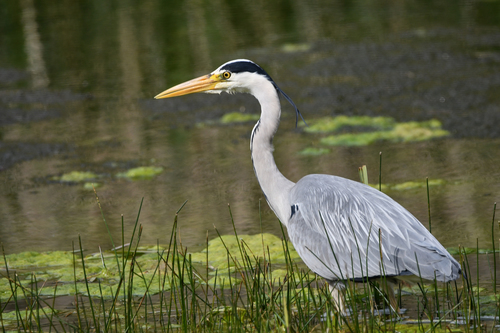
Standing up to 1 metre (3 ft 3 in) tall, adults weigh from 1 to 2 kg (2 to 4 lb). They have a white head and neck with a broad black stripe that extends from the eye to the black crest. The body and wings are grey above and the underparts are greyish-white, with some black on the flanks. The long, sharply pointed beak is pinkish-yellow and the legs are brown.
The birds breed colonially in spring in heronries, usually building their nests high in trees. A clutch of usually three to five bluish-green eggs is laid. Both birds incubate the eggs for around 25 days, and then both feed the chicks, which fledge when 7-8 weeks old. Many juveniles do not survive their first winter, but if they do, they can expect to live for about 5 years.
In Ancient Egypt, the deity Bennu was depicted as a heron in New Kingdom artwork. In Ancient Rome, the heron was a bird of divination. Roast heron was once a specially prized dish; when George Neville became Archbishop of York in 1465, 400 herons were served to the guests. Wikipedia →
Recent sightings of Grey Heron in Yerevan
LIVEiNaturalistGlobal Distribution
Parks Where Found
Zoos & Centres Where Found
Closest Relatives at Yerevan







Before you go
What are the chances of seeing a Grey Heron in Yerevan?
Possible
About 20% of wildlife watchers report a Grey Heron sighting in Yerevan on a given day, based on 37 verified sightings from GBIF citizen-science data. It is the 31st most-seen of the 90 birds we can rate there. Over three days the chance rises to about 40%, and over a week to about 70%, if each day is a fresh chance.
When is the best time to see a Grey Heron in Yerevan?
December
In that month about 40% of wildlife watchers report a Grey Heron in Yerevan on a given day, against about 10% in February, May–July and September, the lowest months.
What time of day is best to see a Grey Heron?
Between 4 and 7 pm
Across all the parks we cover, that three-hour window holds the most Grey Heron sightings with a recorded time, and about 8 in 10 of them come between 6 am and 6 pm: it is a daytime animal.
Is Yerevan the best place to see a Grey Heron?
120th of 215
Of the 215 cities where we can rate Grey Heron sightings, Yerevan ranks 120th at about 20%. The best odds are in Daejeon (South Korea, about 80%), Osaka (Japan, about 70%) and Amsterdam (Netherlands, about 70%).
Where does the Grey Heron sighting chance come from?
GBIF citizen-science records
It is estimated from how often the Grey Heron is recorded against all the birds logged in Yerevan (37 verified sightings), calibrated against known sighting rates. Figures are rounded to the nearest 10% because citizen-science data supports honest approximations, not decimals, and months with records from fewer than five people show "—". How it works.
