Blue-black Grassquit

Blue-black Grassquit

Volatinia jacarina

Silhouette: Sheatherius · PhyloPic

LCLeast ConcernNTVUENCR
Daily sighting probability ~10% · With luck
at Campo Grande

In 3 days ~30% in a week ~60%

120 Verified sightings at Campo Grande
12,498 In all 73 parks From 2019 to 2026
January Best month
☀️ Diurnal When it's spotted

About the Blue-black Grassquit

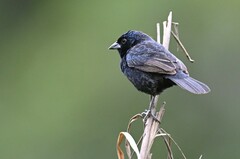
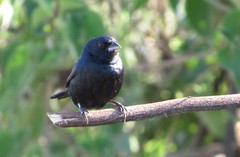
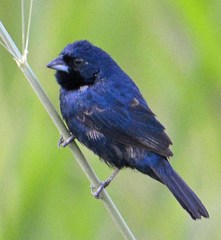
The blue-black grassquit (Volatinia jacarina) is a small Neotropical bird in the family Thraupidae, the tanagers and allies. It is found in Mexico, every Central American country, every mainland South American country, in Trinidad and Tobago, and in Grenada.

The blue-black grassquit was formally described by the Swedish naturalist Carl Linnaeus in 1766 in the twelfth edition of his Systema Naturae under the binomial name Tanagra jacarina. Linnaeus based his description on the "Jacarni" that was described in 1648 by the German naturalist Georg Marcgrave in his Historia Naturalis Brasiliae. The type locality is eastern Brazil. The specific epithet jacarina is derived from the Tupi language and was used for a type of finch. The blue-black grassquit is now the only species in the genus Volatinia that was introduced in 1850 by the German naturalist Ludwig Reichenbach. The genus name is a diminutive of the Latin volatus meaning "flying".

Within the tanager family Thraupidae the blue-black grassquit is in the subfamily Tachyphoninae and is a member of a clade that contains the genera Conothraupis and Creurgops. It was formerly placed with the buntings in the... Wikipedia →

Sounds

Song1:27

Ecuador · 2023

© Manuel Sánchez-Nivicela · XC1178665 · CC BY-NC-ND 4.0

Call0:13

French Guiana · 2024

© Tristan Guillebot de Nerville · XC1093137 · CC BY-NC-SA 4.0

Tui tui0:47

Brazil · 2024

© Jose Luiz · XC879566 · CC BY-NC-SA 4.0

Global Distribution

Parks Where Found

# Park Country Daily sighting probability
1 Emas National Park 🇧🇷 Brazil
~70%
2 Serra da Canastra National Park 🇧🇷 Brazil
~50%
3 Cerro Azul Meámbar National Park 🇭🇳 Honduras
~30%
4 Chapada Diamantina National Park 🇧🇷 Brazil
~30%
5 Cusuco National Park 🇭🇳 Honduras
~30%
6 Caroni Swamp 🇹🇹 Trinidad and Tobago
~30%
7 Main Ridge Forest Reserve 🇹🇹 Trinidad and Tobago
~30%
8 Lago de Yojoa 🇭🇳 Honduras
~20%
9 Piedras Blancas National Park 🇨🇷 Costa Rica
~20%
10 Soberanía National Park 🇵🇦 Panama
~20%
11 Marino Ballena National Park 🇨🇷 Costa Rica
~20%
12 Chapada dos Guimarães National Park 🇧🇷 Brazil
~20%
13 Sierra de la Macarena National Park 🇨🇴 Colombia
~10%
14 Volcán Barú National Park 🇵🇦 Panama
~10%
15 Manuel Antonio National Park 🇨🇷 Costa Rica
~10%
16 Chagres National Park 🇵🇦 Panama
~10%
17 Cañón del Sumidero National Park 🇲🇽 Mexico
~10%
18 Iberá National Park 🇦🇷 Argentina
~10%
19 Carara National Park 🇨🇷 Costa Rica
~10%
20 Calakmul Biosphere Reserve 🇲🇽 Mexico
~10%
21 La Amistad International Park (Panama) 🇵🇦 Panama
~10%
22 Pico Bonito National Park 🇭🇳 Honduras
~10%
23 Manu National Park 🇵🇪 Peru
~10%
24 Henri Pittier National Park 🇻🇪 Venezuela
~10%
25 Montes Azules Biosphere Reserve 🇲🇽 Mexico
~10%
26 Celaque National Park 🇭🇳 Honduras
~10%
27 Tenorio Volcano National Park 🇨🇷 Costa Rica
~10%
28 Braulio Carrillo National Park 🇨🇷 Costa Rica
~10%
29 Machalilla National Park 🇪🇨 Ecuador
~10%
30 El Triunfo 🇲🇽 Mexico
~10%
31 Cahuita National Park 🇨🇷 Costa Rica
~10%
32 Parque Estadual Encontro das Águas 🇧🇷 Brazil
~10%
33 Masaya Volcano National Park 🇳🇮 Nicaragua
~10%
34 Arenal Volcano National Park 🇨🇷 Costa Rica
~10%
35 Palo Verde National Park 🇨🇷 Costa Rica
~10%
36 Serra dos Órgãos National Park 🇧🇷 Brazil
~10%
37 El Impenetrable National Park 🇦🇷 Argentina
~10%
38 Tayrona National Natural Park 🇨🇴 Colombia
~10%
39 Farallones de Cali National Natural Park 🇨🇴 Colombia
~10%
40 Cockscomb Basin Wildlife Sanctuary 🇧🇿 Belize
~10%
41 Amacayacu National Natural Park 🇨🇴 Colombia
<5%
42 Gandoca-Manzanillo Wildlife Refuge 🇨🇷 Costa Rica
<5%
43 San Lorenzo Protected Forest 🇵🇦 Panama
<5%
44 Corcovado National Park 🇨🇷 Costa Rica
<5%
45 Las Baulas Marine National Park 🇨🇷 Costa Rica
<5%
46 Rincón de la Vieja National Park 🇨🇷 Costa Rica
<5%
47 Anavilhanas National Park 🇧🇷 Brazil
<5%
48 Bastimentos Island National Marine Park 🇵🇦 Panama
<5%
49 La Tigra National Park 🇭🇳 Honduras
<5%
50 Parque Natural Metropolitano 🇵🇦 Panama
<5%
51 Santa Rosa National Park 🇨🇷 Costa Rica
<5%
52 El Palmar National Park 🇦🇷 Argentina
<5%
53 Tijuca National Park 🇧🇷 Brazil
<5%
54 Tambopata National Reserve 🇵🇪 Peru
<5%
55 Cabo Blanco Absolute Nature Reserve 🇨🇷 Costa Rica
<5%
56 Darién National Park 🇵🇦 Panama
<5%
57 Ostional Wildlife Refuge 🇨🇷 Costa Rica
<5%
58 Tortuguero National Park 🇨🇷 Costa Rica
<5%
59 Itatiaia National Park 🇧🇷 Brazil
<5%
60 Yasuní National Park 🇪🇨 Ecuador
<5%
61 Iguazú National Park 🇦🇷 Argentina
<5%
62 Iguaçu National Park 🇧🇷 Brazil
<5%
63 Podocarpus National Park 🇪🇨 Ecuador
<5%
64 Biotopo Cerro Cahuí 🇬🇹 Guatemala
<5%
65 Poás Volcano National Park 🇨🇷 Costa Rica
<5%
66 Tapantí-Macizo de la Muerte National Park 🇨🇷 Costa Rica
<5%
67 Chirripó National Park 🇨🇷 Costa Rica
<5%
68 Ría Lagartos Biosphere Reserve 🇲🇽 Mexico
<5%
69 Sian Ka'an Biosphere Reserve 🇲🇽 Mexico
<5%
70 Los Nevados National Natural Park 🇨🇴 Colombia
<5%
71 Tikal National Park 🇬🇹 Guatemala
<5%
72 Celestún Biosphere Reserve 🇲🇽 Mexico
<5%
73 Monteverde Cloud Forest Reserve 🇨🇷 Costa Rica
<5%

Cities Where Found

# City Country Daily sighting probability
1 San Pedro Sula 🇭🇳 Honduras
~30%
2 Lima 🇵🇪 Peru
~30%
3 Goiânia 🇧🇷 Brazil
~30%
4 Santa Cruz de la Sierra 🇧🇴 Bolivia
~20%
5 Natal 🇧🇷 Brazil
~20%
6 Campinas 🇧🇷 Brazil
~20%
7 São Luís 🇧🇷 Brazil
~10%
8 Campo Grande 🇧🇷 Brazil
~10%
9 Brasilia 🇧🇷 Brazil
~10%
10 Cali 🇨🇴 Colombia
~10%

Zoos & Centres Where Found

# Zoo / Centre Country
1 Basel Zoo 🇨🇭 Switzerland In captivity
2 Burgers' Ocean 🇳🇱 Netherlands In captivity
3 Royal Burgers' Zoo 🇳🇱 Netherlands In captivity
4 Zoo Lagos 🇵🇹 Portugal In captivity
5 Butterfly World 🇺🇸 United States In captivity

Before you go

What are the chances of seeing a Blue-black Grassquit in Campo Grande?

With luck

About 10% of wildlife watchers report a Blue-black Grassquit sighting in Campo Grande on a given day, based on 120 verified sightings from GBIF citizen-science data. It is the 78th most-seen of the 221 birds we can rate there. Over three days the chance rises to about 30%, and over a week to about 60%, if each day is a fresh chance.

When is the best time to see a Blue-black Grassquit in Campo Grande?

January

In that month about 40% of wildlife watchers report a Blue-black Grassquit in Campo Grande on a given day, against under 5% in May–June and August, the lowest months. That is one of Campo Grande's wettest months, with about 200 mm of rain against 30 mm in July.

What time of day is best to see a Blue-black Grassquit?

Between 7 and 10 am

Across all the parks we cover, that three-hour window holds the most Blue-black Grassquit sightings with a recorded time, and about 9 in 10 of them come between 6 am and 6 pm: it is a daytime animal.

Is Campo Grande the best place to see a Blue-black Grassquit?

8th of 35

Of the 35 cities where we can rate Blue-black Grassquit sightings, Campo Grande ranks 8th at about 10%. The best odds are in San Pedro Sula (Honduras, about 30%), Lima (Peru, about 30%) and Goiânia (Brazil, about 30%).

Which relatives of the Blue-black Grassquit live in Campo Grande?

Same family: Thraupidae

The closest relatives of the Blue-black Grassquit that you can see in Campo Grande (family Thraupidae, Tanagers and Allies) are Sayaca Tanager (about 80%), Saffron Finch (about 60%) and Bananaquit (about 60%), with each one's daily chance of a sighting.

Where does the Blue-black Grassquit sighting chance come from?

GBIF citizen-science records

It is estimated from how often the Blue-black Grassquit is recorded against all the birds logged in Campo Grande (120 verified sightings), calibrated against known sighting rates. Figures are rounded to the nearest 10% because citizen-science data supports honest approximations, not decimals, and months with records from fewer than five people show "—". How it works.

← Back to Campo Grande