


Completed


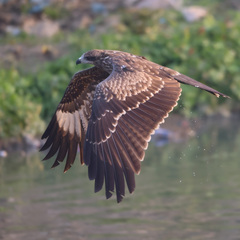
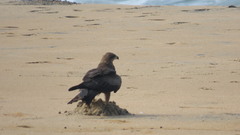

Black Kite
Milvus migrans
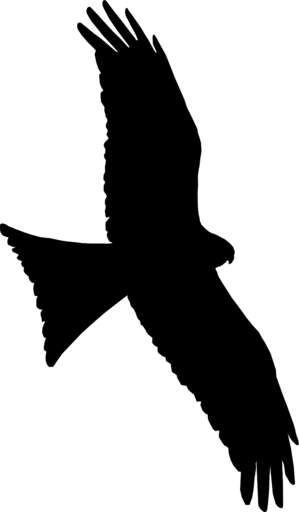
Silhouette: PhyloPic
- KingdomAnimalia (Animals)
- PhylumChordata (Chordates)
- ClassAves (Birds)
- OrderAccipitriformes (Hawks, Eagles, Kites, and Allies)
- FamilyAccipitridae (Hawks, Eagles, and Kites)
- GenusMilvus (Milvus Kites)
- SpeciesMilvus migrans (Black Kite)
In 3 days ~20% in a week ~30%
5 Verified sightings at Golden Gate Highlands National Park From 2019 to 2026
26,976 In all 102 parks
January Best month
☀️ Diurnal When it's spotted

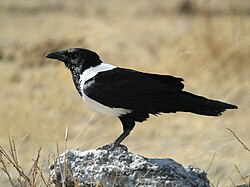

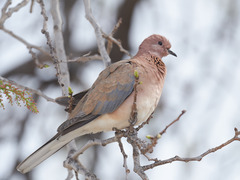

Completed
About the Black Kite
The black kite or fire kite (Milvus migrans) is a medium-sized bird of prey in the family Accipitridae, which also includes many other diurnal raptors. It is thought to be the world's most abundant species of Accipitridae, although some populations have experienced dramatic declines or fluctuations. Current global population estimates run up to 6.7 million individuals.
Unlike others of the group, black kites are opportunistic hunters and are more likely to scavenge. They spend much of their time gliding in thermals in search of food. Their angled wing and distinctive forked tail make them easy to identify. They are vociferous with a distinct shrill whinnying call.
The black kite is widely distributed through temperate and tropical parts of Eurasia and parts of Australasia and Oceania. Temperate populations tend to be migratory. Several subspecies are recognized, with several having previously had English names. The European populations are small, but the South Asian population is comparatively very large.
The black kite was described by the French polymath Georges-Louis Leclerc, Comte de Buffon in his Histoire Naturelle des Oiseaux in 1770. The bird was... Wikipedia →
Recent sightings of Black Kite in Golden Gate Highlands National Park
LIVEiNaturalistGlobal Distribution
Parks Where Found
Cities Where Found
| # | City | Country | Daily sighting probability |
|---|---|---|---|
| 1 | Islamabad | 🇵🇰 Pakistan | |
| 2 | Visakhapatnam | 🇮🇳 India | |
| 3 | Agra | 🇮🇳 India | |
| 4 | Serrekunda | 🇬🇲 Gambia | |
| 5 | Hajipur | 🇮🇳 India | |
| 6 | Bengaluru | 🇮🇳 India | |
| 7 | Karachi | 🇵🇰 Pakistan | |
| 8 | Srinagar | 🇮🇳 India | |
| 9 | Ranchi | 🇮🇳 India | |
| 10 | Kathmandu | 🇳🇵 Nepal |
Zoos & Centres Where Found
Closest Relatives at Golden Gate Highlands National Park




Before you go
What are the chances of seeing a Black Kite in Golden Gate Highlands National Park?
With luck
About 10% of wildlife watchers report a Black Kite sighting in Golden Gate Highlands National Park on a given day, based on 5 verified sightings from GBIF citizen-science data from 2019 to 2026. It is the 103rd most-seen of the 108 birds we can rate there. Over three days the chance rises to about 20%, and over a week to about 30%, if each day is a fresh chance.
When is the best time to see a Black Kite in Golden Gate Highlands National Park?
January
In that month about 20% of wildlife watchers report a Black Kite in Golden Gate Highlands National Park on a given day, against under 5% in February, April–August and October–December, the lowest months. That is one of Golden Gate Highlands National Park's wettest months, with about 130 mm of rain against 15 mm in June. March has too few records to rate.
What time of day is best to see a Black Kite?
Between 9 am and noon
Across all the parks we cover, that three-hour window holds the most Black Kite sightings with a recorded time, and nearly all of them come between 6 am and 6 pm: it is a daytime animal.
Is Golden Gate Highlands National Park the best place to see a Black Kite?
65th of 102
Of the 102 parks where we can rate Black Kite sightings, Golden Gate Highlands National Park ranks 65th at about 10%. The best odds are in Berenty Reserve (Madagascar, over 90%), Nairobi National Park (Kenya, about 70%) and Nikko National Park (Japan, about 60%). All parks ranked.
Which relatives of the Black Kite live in Golden Gate Highlands National Park?
Same family: Accipitridae
The closest relatives of the Black Kite that you can see in Golden Gate Highlands National Park (family Accipitridae, Hawks, Eagles, and Kites) are Jackal Buzzard (about 60%), Cape Griffon (about 40%) and Bearded Vulture (about 30%), with each one's daily chance of a sighting.
Where does the Black Kite sighting chance come from?
GBIF citizen-science records
It is estimated from how often the Black Kite is recorded against all the birds logged in Golden Gate Highlands National Park (5 verified sightings from 2019 to 2026), calibrated against known sighting rates. Figures are rounded to the nearest 10% because citizen-science data supports honest approximations, not decimals, and months with records from fewer than five people show "—". How it works.
