


Completed

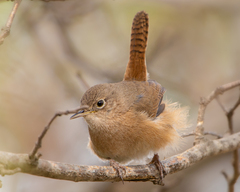


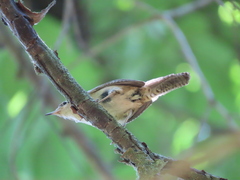

Southern House Wren
Troglodytes musculus
Silhouette: T. Michael Keesey · PhyloPic
- KingdomAnimalia (Animals)
- PhylumChordata (Chordates)
- ClassAves (Birds)
- OrderPasseriformes (Perching Birds)
- FamilyTroglodytidae (Wrens)
- GenusTroglodytes (Troglodytes Wrens)
- SpeciesTroglodytes musculus (Southern House Wren)
In 3 days ~20% in a week ~40%
25 Verified sightings at Biotopo Cerro Cahuí From 2019 to 2026
64,273 In all 83 parks
June Best month
☀️ Diurnal When it's spotted
About the Southern House Wren
The southern house wren (Troglodytes musculus) is a very small passerine bird in the wren family Troglodytidae. It is found from southern Mexico to southern Chile and southern Argentina. The name troglodytes means "hole dweller", and is a reference to the bird's tendency to disappear into crevices when hunting insects or to seek shelter. It was formerly considered to be conspecific with the northern house wren (Troglodytes aedon).
The southern house wren was formally described in 1823 by the German naturalist Johann Andreas Naumann under the binomial name Troglodytes musculus. He specified the type locality as the state of Bahia in eastern Brazil. The specific epithet is Latin meaning "little mouse". The southern house wren was formerly considered to be part of the house wren complex that also included the northern house wren and six insular forms. The southern house wren was split from the complex based on the deep genetic divergence, differences in vocalizations and differences in morphology.
Twenty-one subspecies are recognised: Wikipedia →
Sounds
Recording0:15
Guatemala · 2026
© Julia Carr · iNaturalist · CC BY-NC 4.0
Recording1:00
Brazil · 2026
© Márcio Alves Cardoso · iNaturalist · CC BY-NC 4.0
Recording0:08
Argentina · 2026
© ignaciocostagliola · iNaturalist · CC BY-NC 4.0
Recent sightings of Southern House Wren in Biotopo Cerro Cahuí
LIVEiNaturalistGlobal Distribution
Parks Where Found
Cities Where Found
| # | City | Country | Daily sighting probability |
|---|---|---|---|
| 1 | Santiago | 🇨🇱 Chile | |
| 2 | Natal | 🇧🇷 Brazil | |
| 3 | Caracas | 🇻🇪 Venezuela | |
| 4 | Rio de Janeiro | 🇧🇷 Brazil | |
| 5 | Bogota | 🇨🇴 Colombia | |
| 6 | Cordoba | 🇦🇷 Argentina | |
| 7 | Buenos Aires | 🇦🇷 Argentina | |
| 8 | Niterói | 🇧🇷 Brazil | |
| 9 | Rosario | 🇦🇷 Argentina | |
| 10 | Manaus | 🇧🇷 Brazil |
Closest Relatives at Biotopo Cerro Cahuí




Before you go
What are the chances of seeing a Southern House Wren in Biotopo Cerro Cahuí?
With luck
About 10% of wildlife watchers report a Southern House Wren sighting in Biotopo Cerro Cahuí on a given day, based on 25 verified sightings from GBIF citizen-science data from 2019 to 2026. It is the 107th most-seen of the 191 birds we can rate there. Over three days the chance rises to about 20%, and over a week to about 40%, if each day is a fresh chance.
When is the best time to see a Southern House Wren in Biotopo Cerro Cahuí?
June and August
In those months about 20% of wildlife watchers report a Southern House Wren in Biotopo Cerro Cahuí on a given day, against under 5% in May, July and October, the lowest months. Those are among Biotopo Cerro Cahuí's wettest months, with about 190 mm of rain a month against 25 mm in March.
What time of day is best to see a Southern House Wren?
Between 9 am and noon
Across all the parks we cover, that three-hour window holds the most Southern House Wren sightings with a recorded time, and about 9 in 10 of them come between 6 am and 6 pm: it is a daytime animal.
Is Biotopo Cerro Cahuí the best place to see a Southern House Wren?
69th of 83
Of the 83 parks where we can rate Southern House Wren sightings, Biotopo Cerro Cahuí ranks 69th at about 10%. The best odds are in Tijuca National Park (Brazil, about 80%), Tierra del Fuego National Park (Argentina, about 70%) and Serra dos Órgãos National Park (Brazil, about 70%). All parks ranked.
Which relatives of the Southern House Wren live in Biotopo Cerro Cahuí?
Same family: Troglodytidae
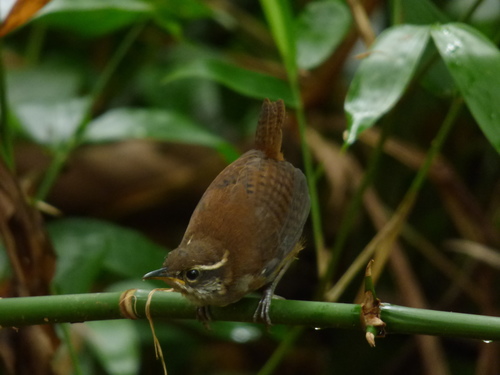
The closest relatives of the Southern House Wren that you can see in Biotopo Cerro Cahuí (family Troglodytidae, Wrens) are Spot-breasted Wren (about 20%), White-breasted Wood-Wren (about 10%) and White-bellied Wren (about 10%), with each one's daily chance of a sighting.
Where does the Southern House Wren sighting chance come from?
GBIF citizen-science records
It is estimated from how often the Southern House Wren is recorded against all the birds logged in Biotopo Cerro Cahuí (25 verified sightings from 2019 to 2026), calibrated against known sighting rates. Figures are rounded to the nearest 10% because citizen-science data supports honest approximations, not decimals, and months with records from fewer than five people show "—". How it works.
