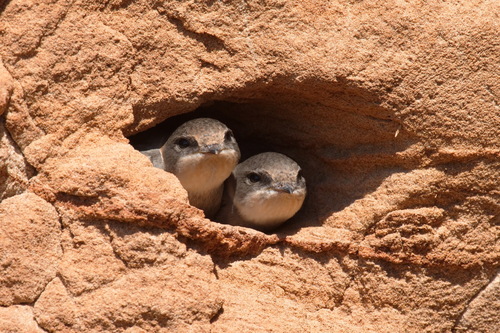
About the Bank Swallow
The sand martin (Riparia riparia), also known as the collared sand martin or common sand martin, and in the Americas as the bank swallow, is a migratory passerine bird in the swallow family Hirundinidae. It has a wide range in summer, embracing practically the whole Holarctic area, from Europe, across Asia to the Pacific Ocean, and throughout North America. It winters in eastern and southern Africa, southern Asia, and South America.
This species was first described by Carl Linnaeus in his 1758 10th edition of Systema Naturae, and originally named Hirundo riparia; the description consisted of the simple "H[irundo] cinerea, gula abdomineque albis" ("an ash-grey swallow, with white throat and belly") and the type locality was simply given as "Europa", subsequently refined to refer to Linnaeus's homeland of Sweden. The specific name means "of the riverbank"; it is derived from the Latin ripa "riverbank".
There are three or four weakly defined subspecies: Breeds Europe, western Asia, North America; winters Africa, South America. Wikipedia →