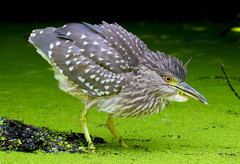
The black-crowned night heron (Nycticorax nycticorax) or black-capped night heron, commonly shortened to just night heron in Eurasia, is a medium-sized heron found throughout a large part of the world, including parts of Africa, Asia, Europe, and North and South America. In Australasia it is replaced by the closely related Nankeen night heron (N. caledonicus), with which it has hybridised in the area of contact.
The black-crowned night heron was formally described by the Swedish naturalist Carl Linnaeus in 1758 in the tenth edition of his Systema Naturae. He placed it with herons, cranes and egrets in the genus Ardea and coined the binomial name Ardea nycticorax, based on specimens from southern Europe. It is now placed in the genus Nycticorax that was described in 1817 by the English naturalist Thomas Forster for this species. The epithet nycticorax is from Ancient Greek and combines nux, nuktos meaning "night" and korax meaning "raven". The word was used by authors such as Aristotle and Hesychius of Miletus for a "bird of ill omen", perhaps an owl. The word was used by the Swiss naturalist Conrad Gessner in 1555 and then by subsequent authors for a black-crowned...